Somfy Smart Home: Motorized Blinds, Shades, Automation

This post may contain affiliate links. As an Amazon Associate we earn from qualifying purchases. Disclosure.
Somfy motorized blinds and shades automate window coverage in ways manual blinds never could. Here are setup guides and product reviews for the full Somfy lineup.
Quick take: Somfy has made motorized blinds and shades since 1969, longer than the smart home category has existed. Their TaHoma Switch hub bridges Somfy's proprietary RTS and io-homecontrol radio protocols to Alexa, Google Home, and Apple HomeKit. RTS motors receive commands only (no position feedback); io-homecontrol motors report exact position and respond to percentage commands like "open to 40%." Battery-powered WireFree motors are the DIY retrofit option, no electrician needed. For energy management, sun angle automations (closing south-facing shades when direct sunlight hits) reduce cooling load measurably; Home Assistant has built-in sun position calculation to drive these.
Motorized window coverings occupy a specific niche in the smart home market: they're among the highest-impact automations for comfort and energy management, and among the least glamorous to talk about. But automated blinds and shades do something most smart home devices don't, they manage the largest uncontrolled variable in a home's thermal performance.
Somfy has built motorized blinds and shades since 1969. The company predates the smart home category by decades, which explains why their products are engineered differently from startups entering the space with a Wi-Fi chip and an app. The motors are designed for daily use over years, not demos at a trade show.
If you're still deciding between Somfy and the alternatives, the Somfy vs competitors comparison covers Lutron, Hue, and SwitchBot side by side on price, ecosystem support, and reliability. Already sold on the brand and just want the short case for it? Five reasons Somfy wins on smart window treatments sums it up.
Why Are Window Coverings Worth Automating?
Solar heat gain through windows accounts for a significant portion of summer cooling load in most homes. A south-facing room with uncovered windows gains heat throughout the day and forces the HVAC system to work harder. Blinds that automatically close when direct sunlight hits the window reduce that load without requiring anyone to remember to close them.
A US Department of Energy fact sheet on interior cellular shades reports that Oak Ridge National Laboratory testing found cellular shades saved up to 20 percent on heating energy and up to 15 percent on total heating and cooling energy compared with no shades at all. Motorized shades make that kind of result automatic rather than theoretical.
The comfort dimension is equally practical. Morning sun hitting a bedroom at 6 AM wakes people up earlier than intended. A shade that opens gradually at 7:30 and closes by noon on east-facing windows requires a schedule set once, then runs indefinitely.
Privacy control is the third dimension most people don't think about until they have it. A schedule that closes front-facing shades at dusk automatically means you never forget, and in rooms facing the street, that's a habit that's easy to miss.
How Does Somfy's Ecosystem Work?
Somfy uses three radio protocols depending on the product line: RTS (Radio Technology Somfy), io-homecontrol, and more recently Z-Wave and Zigbee for integration with broader smart home platforms.
RTS is the older of Somfy's radio protocols. It's one-way communication, the motor receives commands but doesn't confirm position or status. This works reliably but means your hub doesn't know the current shade position unless you send a command.
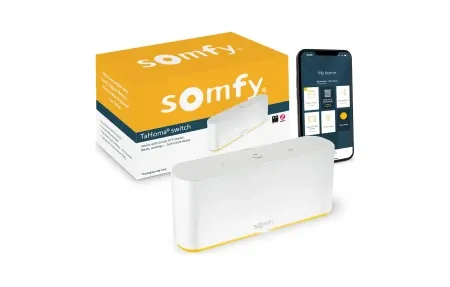
io-homecontrol supports bidirectional communication: the motor reports its exact position, and the hub can set the shade to a specific percentage open rather than just full open or closed. The Somfy TaHoma hub supports io-homecontrol devices and integrates with Apple HomeKit, Google Home, and Amazon Alexa through the TaHoma switch.
Understanding which protocol your Somfy devices use matters for automation planning:
- RTS motors: Simple on/off/stop control; no position feedback; compatible with Somfy Telis remotes and most hubs via TaHoma
- io-homecontrol motors: Position control (0-100%); bidirectional; supported by TaHoma and direct integration with newer smart home systems
- Zigbee/Z-Wave Somfy: Native integration with SmartThings, Hubitat, and Home Assistant without TaHoma

TaHoma Switch vs TaHoma v2 vs Connexoon: which hub?
Somfy sells more than one bridge, and the one you pick decides which voice platforms and which extras you get. Here's how the three current options separate:
| Hub | Protocols | Voice platforms | Local scene button | Best for |
|---|---|---|---|---|
| TaHoma Switch | io-homecontrol, RTS, Zigbee | Google Home, Alexa, Apple HomeKit | Yes | Most new setups; mixed-protocol homes |
| TaHoma v2 | io-homecontrol, RTS | Google Home, Alexa, Apple HomeKit (io-homecontrol devices only) | No | Existing installs that don't need Zigbee |
| Connexoon | io-homecontrol (variant-specific) | Google Home, Alexa; HomeKit only through third-party bridges | No | Single-purpose setups, one variant per job |
The Switch is the one I'd pick today. It adds Zigbee and a physical scene button the older hubs lack, and Somfy's own HomeKit documentation lists it alongside the second-generation TaHoma box as HomeKit-capable. TaHoma v2 does everything the Switch does minus Zigbee and the scene button, so it's worth keeping if you already own one rather than buying up. Connexoon is the compact, app-only option Somfy splits into use-case variants (Window for interior shades, Terrace for awnings), which keeps it cheaper but locks you to a narrower job; one retailer notes the Connexoon Window RTS variant has been discontinued for new installs. One point that matters for a Home Assistant house: all three expose devices to HA through the same local TaHoma API, so the hub choice is about voice assistants and Zigbee, not about whether HA can see the shades.
What Somfy Product Lines Are Available?
Somfy's product catalog covers both new installations and retrofit options for existing window coverings.
Motorized roller shades: The highest-integration option. Somfy motors fit standard roller shade tubes, and these work with their full control ecosystem. Available in both battery-powered and hardwired versions.
Motorized Roman shades: Similar to roller shades in function, with a pleated fabric look. Somfy motors adapt to this style through compatible lift systems.
Motorized horizontal blinds (tilt and lift): The Somfy Sonesse and WireFree motors retrofit onto existing horizontal blinds, controlling both tilt (louver angle) and lift (blind height).
Exterior shutters and awnings: Somfy also makes motors for exterior installations, patio awnings, shutters, pergola screens. These use the same TaHoma ecosystem as indoor blinds.
Control options:
- Somfy Situo and Telis remotes (standalone, no hub required)
- TaHoma Switch hub (enables app control + voice assistant integration)
- Direct Z-Wave/Zigbee for SmartThings/Home Assistant integration
How Does Somfy Integrate With Smart Home Platforms?
Somfy's TaHoma hub bridges their proprietary protocols to mainstream smart home platforms. Through TaHoma, Somfy blinds appear in Google Home, Amazon Alexa, and Apple HomeKit as standard accessories. A morning routine can include "open the living room shades to 40 percent" alongside coffee maker activation and thermostat adjustment.
Home Assistant integration is available through the Somfy TaHoma integration, which exposes all connected devices and supports position control for io-homecontrol devices.
For users running Home Assistant with Zigbee2MQTT or Z-Wave JS, Somfy's newer Zigbee and Z-Wave motors integrate without TaHoma at all. This local-control path is faster (no cloud round-trip) and works even when the internet is down. It's the path I'd choose for any new installation where you're already running Home Assistant.
Voice control with Alexa or Google Home works well for shade control. "Alexa, set the living room shades to 50 percent" is a genuinely useful command, more useful than a preset open/close because it lets you fine-tune light levels without getting up.

What Is the Somfy TaHoma Switch Like to Live With?
Some context first, so you can weigh what follows. The house I'm finishing has twelve io-homecontrol exterior shutters and a TaHoma Switch as their hub, and nobody lives there yet. That means I can't offer months of daily-use data, and I haven't run RTS motors at all. What I can offer is the setup stage and the documentation.
The TaHoma Switch connects over Wi-Fi out of the box and goes wired only if you buy Somfy's separate Ethernet adapter, which is worth it if your Wi-Fi is weak where the hub sits. Setup runs through the app, which then adds devices one protocol at a time. io-homecontrol devices report their position back, so a percentage command like "set the shutter to 30 percent" is meaningful, while an RTS motor can only be told to go, stop, or move to preset positions. For a worked example from my own house, see the walkthrough on pairing a Somfy iZymo transmitter with the TaHoma Switch.
One thing I haven't done yet is link the TaHoma to Home Assistant. The Overkiz integration is on the to-do list, so treat the Home Assistant material below as what the platform supports, not as a record of my own setup. Note that Home Assistant's documentation says Zigbee, Z-Wave, Hue, and Sonos devices connected to a TaHoma are not supported through Overkiz, so the hub's Zigbee abilities don't carry over. Would I buy the TaHoma Switch again? For a mostly io-homecontrol house that wants one app plus voice control, it's a reasonable hub. If you already run Home Assistant and have no Somfy-specific need, check whether the motors you plan to buy have a more open option.
How Do You Set Up Schedules and Automations with Somfy?
The most useful automations for motorized shades are time and sun position based.
Simple time schedules work for rooms where your routine is consistent. Set shades to open at 7:30 AM and close at 8 PM. Takes two minutes to configure in the TaHoma app or your smart home platform.
Sun Angle Automations
Sun angle automations are more sophisticated but significantly more useful for energy management. These require either a smart home hub with sun position calculation (Home Assistant has this built in) or integration with a weather service. When the sun is at an angle that would cause direct glare or heat gain on a specific window, the shade closes automatically. When the sun has moved past that angle, it opens.
Presence-based closing: If everyone leaves the house, close all shades for privacy and energy management. Reopen when someone returns. This works in any smart home platform that supports presence detection through phone location.
Temperature-linked automations: When the outdoor temperature exceeds 85F and the sun is shining, close south and west-facing shades automatically. This is where energy savings become measurable, the HVAC runs less because you're blocking heat at the source.
Example automation workflows in Home Assistant and Node-RED
Concepts are easy to agree with; the useful part is the actual trigger. Here are workflows worth copying, written for Home Assistant because that's the local-control path this build is heading toward. Once the TaHoma integration is connected, Somfy io-homecontrol shades show up as cover entities, so they take standard cover.set_cover_position calls.
A sun-elevation rule that shades a west window through the afternoon:
automation:
  - alias: Shade west window on afternoon sun
    trigger:
      - platform: numeric_state
        entity_id: sun.sun
        attribute: elevation
        below: 30
    condition:
      - condition: state
        entity_id: sun.sun
        attribute: rising
        state: false
      - condition: numeric_state
        entity_id: sensor.outdoor_temperature
        above: 24
    action:
      - service: cover.set_cover_position
        target:
          entity_id: cover.west_living_room
        data:
          position: 25
The two conditions carry the logic: rising: false keeps it to the afternoon, and the temperature check means it only fires when shading actually saves cooling, not on a cold bright day.
For anything with branching logic, Node-RED is the cleaner tool. A "leaving home" flow chains a presence trigger into a set of cover calls with a short delay between each, so a dozen shades don't all move at once and spike the load. Scene chaining works the same way: a single "movie" event drops the blackout shades, then fires the lights, sequenced rather than simultaneous.
One caveat that's specific to RTS motors: without position feedback, an HA cover entity can only estimate where an RTS shade sits, so position-based rules like the one above are reliable only on io-homecontrol hardware.
What Should You Expect During Somfy Installation?
Motorized blinds installation ranges from straightforward to professionally complex depending on what you're replacing.
Battery-powered retrofit motors clip onto existing horizontal blinds without any wiring changes. Somfy positions these as the DIY-friendly option, and they need no special wiring work. Battery life varies with motor size and usage, so check Somfy's figures for your model. The Somfy's WireFree motors use built-in lithium rechargeable batteries with a charging port, which is more convenient than replacing disposables.
Hardwired motors for new roller shade installations require routing power to each window location, which typically means a professional installer for initial setup. The wiring is low-voltage in most systems, but running wire through walls is the part that usually requires a professional.
For retrofit installations, the battery-powered Sonesse WireFree and Glydea WireFree motors are the most popular option. They clip onto existing blinds hardware and eliminate the wiring question entirely. The tradeoff: you'll eventually need to charge or replace batteries.
What Do the Somfy Guides Here Cover?
The product guide covers the full Somfy lineup with specific recommendations for different installation scenarios and budgets. The installation guides walk through retrofit motor installation for the most common blind types, with diagrams for the wiring configurations that require a professional.
The automation guide goes deeper on TaHoma programming, including how to set up position-based schedules for south-facing rooms, integrate with Home Assistant for local control, and connect Somfy devices to Alexa routines that go beyond simple open/close commands.
If you're evaluating Somfy against competitors like Lutron Serena or Hunter Douglas PowerView, the comparison guide covers the protocol differences, price points, and smart home integration quality across all three brands. Somfy's strength is in the breadth of motor options and the maturity of TaHoma integration. The competitors' strength is in fabric quality and shade design options.
How Does Somfy Compare to Lutron Serena and Hunter Douglas?
The three major motorized shade brands each have distinct strengths.
Lutron Serena uses Lutron's proprietary Clear Connect RF protocol, the same technology in Lutron Caseta switches. It's extremely reliable, Lutron's reputation for rock-solid RF performance carries over from their commercial lighting work. The limitation is a more limited selection of fabric and shade styles compared to Somfy and Hunter Douglas.
Hunter Douglas PowerView is the premium end of the market. The fabric selection and custom sizing options are the best available, and the PowerView Gen 3 hub now supports Matter. The tradeoff is cost, PowerView shades are significantly more expensive than comparable Somfy options, and the hub and accessories add to the total.
Somfy sits in the middle: broader motor options and retrofit flexibility than Lutron Serena, more accessible pricing than Hunter Douglas, and a more mature smart home integration story than either competitor. TaHoma added HomeKit in late 2020, after Alexa and Google Assistant support.
How Do You Manage Power: Battery vs Hardwired Somfy Devices?
Battery-powered motors are the most popular for retrofits because they don't require an electrician. Somfy's WireFree motors use internal lithium rechargeable batteries, and the charging cable depends on the model, so check which one yours takes. Charge interval depends on shade size and usage frequency, so check Somfy's figures for your motor.
Hardwired motors run on standard line voltage stepped down through a transformer, or on low-voltage DC power in more modern installations. For a new construction or renovation project, hardwired motors eliminate the charging maintenance entirely. They're also quieter, the motor controller doesn't need the extra electronics that wireless motors carry.
A hybrid approach works well for larger homes: hardwire the frequently-used shades in main living areas where running power is practical, and use battery motors for bedrooms and less-used rooms where wiring would be more disruptive.
How Do You Use Seasonal Automation to Get the Most from Motorized Shades?
The full value of motorized shades shows up in seasonal routines.
In summer, the goal is blocking solar heat gain during peak hours. South and west-facing windows gain the most heat in the afternoon. A schedule that closes those shades at noon and reopens them after 5 PM blocks the hottest part of the day. Paired with a smart thermostat, this can reduce AC runtime measurably on sunny days.
In winter, the goal flips: maximize solar gain during the day, then close all shades at dusk to reduce heat loss through the glass. A single sunset-triggered routine covering all windows keeps your heating bill lower without daily manual effort.
I don't have my own before-and-after numbers yet, because the house isn't lived in, so I won't quote a temperature drop. A good rule of thumb: motorized shades pay for themselves fastest in rooms with large, south-facing windows in climates with hot summers. The energy savings are most measurable there.
The hazard for external shutters is frost, not wind
Wind sensors get sold with everything, and for awnings and fabric screens they earn it: an extending arm or a tensioned sheet in a gust is a repair bill. External roller shutters running in guide rails are a different object. They sit flat against the facade, the rails carry the load, and a gust does very little to them. All twelve of mine are external shutters, and wind is the sensor I'm least interested in.
Cold is the one that matters. A shutter with water in the rails freezes to them, and a motor that can't tell the difference between ice and an end stop will keep pulling against it. Modern io motors detect an obstacle and stop, which protects the motor and does nothing for the slat that already bent. So the automation worth writing isn't a wind rule, it's a temperature lockout: below roughly zero outside, or after freezing rain, the schedule doesn't touch the shutters and you open them by hand once you've looked at them. Sun and light sensors are the ones actually on my list, because those drive the shading logic that pays for itself.
These guides cover all of this, product selection, installation, TaHoma configuration, and seasonal automation strategies, with enough detail to plan and execute a motorized shade setup from scratch.
Frequently Asked Questions
What is TaHoma and how does it work?
TaHoma is Somfy's central hub that bridges its proprietary RTS and io- homecontrol radio protocols to your network, making motorized blinds, shutters, and awnings controllable through the TaHoma app and, depending on the hub model, Google Home, Alexa, and Apple HomeKit. RTS is unidirectional, the hub sends commands but gets no position confirmation back, so the app shows an estimated position. io-homecontrol is bidirectional, meaning the hub knows the current position of the motor. Scenes work across all connected devices: a "morning" scene can open every shutter in the house at once and hand off to Google Home or Alexa for voice control. Home Assistant users can add TaHoma through the official Overkiz integration, which supports a local API through Developer Mode on gateways such as the TaHoma Switch.
Are Somfy products compatible with Google Home and Alexa?
Yes, but only through the TaHoma hub, direct WiFi to Google Home or Alexa isn't available because Somfy's RTS and io-homecontrol protocols don't speak WiFi natively. With TaHoma linked, "OK Google, open the living room blinds" works like any other cover command. "Alexa, set the blinds to 50%" works for partial position with io-homecontrol motors only; RTS motors can only go fully open or closed via voice, no percentages. Apple HomeKit support depends on the hub model: Somfy's HomeKit FAQ says it covers the second-generation TaHoma box and newer boxes, and only io-homecontrol window coverings and terrace products, not RTS motors, gates, garage doors, or locks. The TaHoma Switch's CSA certification is for Zigbee 3.0, not Matter, and a Somfy forum moderator has said a Matter gateway is planned with no date, so the TaHoma hub remains the required intermediary for voice assistant integration. Check Somfy's compatibility page for your specific product before purchasing, not every motor model connects to TaHoma.
What types of window coverings can Somfy motors automate?
Somfy makes motors for roller blinds, Roman shades, curtain tracks, Venetian blinds, exterior shutters, pergola covers, and garage doors. Each motor type uses a specific family: Sonesse for interior blinds (quiet, designed for bedrooms), Oximo for exterior roller shutters (weatherproof housing), Glydea for curtain tracks. The key spec to check before buying is the motor's rated torque in Nm against the weight of your covering and the diameter of the tube it drives. A heavy exterior shutter needs a much stronger motor than a light interior roller blind, and Somfy's selection tables list the maximum load for each motor. WireFree battery-powered motors handle retrofits without running new electrical wiring, which matters in older homes. The process: measure shade width, weigh the covering, confirm the torque rating with some headroom, then choose the motor family that matches your covering type.
Sources & References
- Home Assistant - Overkiz home-assistant.io
- Home Assistant - Somfy MyLink home-assistant.io
- Home Assistant - Matter home-assistant.io