Gree Versati III Split: The 10 kW Air-to-Water Heat Pump Behind Our Floor Heating
Product Details
🏭 Manufacturer: Gree
🆔 Model Number: GRS-CQ10Pd/NhH-M
🔧 Usage: Space Heating, Cooling and Domestic Hot Water
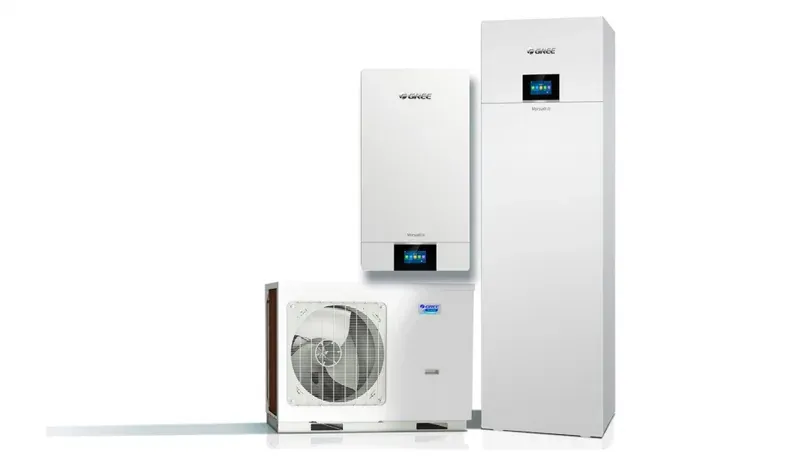
The Gree Versati III Split is the heat pump behind our floor heating. It's a 10 kW class air-to-water unit in two boxes: an outdoor module and a wall-hung hydrobox indoors. It runs on R32 and feeds about 159 m2 of underfloor loops, plus a separate 100-litre buffer tank and a 200-litre hot water cylinder. The house isn't lived in yet. So this page is a spec sheet with a smart home verdict, not a winter diary. Every number below comes from Gree's catalogue sheets, and I'll say so where it matters.
Does It Fit a Home Assistant House?
Short answer: yes, but not through the app. The Versati ships with Wi-Fi and the Gree+ app. That app is cloud only. Your phone talks to a Gree server, and the server talks to the heat pump. Lose the internet and the app goes dark. The heat pump keeps heating on its own schedule, which is what you'd want, but remote control is gone.
The local route is the Modbus BMS port on the back of the wired touch controller. Gree documents it as a building management interface. It's Modbus RTU over RS485: 9600 baud, 8 data bits, no parity, 1 stop bit. An ESP32 and a cheap RS485 board turn that port into a Home Assistant device that survives a router reboot and never asks for a login. I wrote up the register map, the wiring and the ESPHome config in Gree Versati III in Home Assistant with ESPHome Modbus. Two rules from Gree's own document matter most. The unit only accepts "write multiple" commands, and a mode change only takes while the unit is off.
What about the built-in Gree integration in Home Assistant? It targets air conditioners, so a Versati shows up with the wrong entities. A community integration speaks the local Wi-Fi protocol, but so far it exposes little beyond a water setpoint. For a heating system, the wired port is the honest answer.
Google Home gets the heat pump through Home Assistant, not from Gree. Expose a climate entity and the household can ask for a warmer floor by voice. Gree doesn't document a Google Home path for the Versati III, so Home Assistant is the bridge.
The Hardware, Spec by Spec
Gree sells the Versati III split from 6 to 16 kW. The 10 kW step comes in two flavours. GRS-CQ10Pd/NhH2-E is single-phase, 220-240 V. GRS-CQ10Pd/NhH-M is three-phase, 380-415 V. Each pairs an outdoor unit, marked (O), with a hydrobox of the same code, marked (I). Ours is the three-phase NhH-M, as written on the installer's quote and in Gree's price list. Ask your installer for the exact suffix before you size the electrical feed.
What the Catalogue Numbers Say
The three-phase unit is rated 10.0 kW of heat at 7 C outside and 35 C water, with a COP of 4.7. That's a catalogue figure at one test point, not a promise for your winter. The family carries an A+++ energy label at 35 C water and A++ at 55 C.
Why does that matter for a floor heating house? Because floor loops run on low water temperatures, and that's where the pump earns its label. Radiators at 55 C would cost you nearly half the efficiency.
Other numbers worth knowing:
- Operating range: heating down to -25 C outside, cooling from +10 to +48 C
- Water outlet: 20-60 C for heating, 7-25 C for cooling, 40-60 C for hot water (80 C with the heater)
- Backup electric heater in the hydrobox: 6 kW in two 3 kW stages
- Refrigerant charge: R32, 1.84 kg for the three-phase unit
- Noise: 55 dB(A) max sound pressure outdoors, 29 dB(A) at the hydrobox
The hydrobox measures 460 x 860 x 318 mm and weighs about 60 kg. The outdoor unit is 982 mm wide and 787 mm tall. Inside sit a Wilo inverter circulation pump, an Alfa Laval plate heat exchanger, a three-way valve for hot water, an expansion vessel and a safety valve. The compressor is Gree's own two-stage rotary design with vapour injection, which is what lets it keep heating at -25 C.
What We Actually Own
Here's the honest boundary. We bought the Versati III split in the 10 kW size with a separate 100-litre buffer tank and a 200-litre domestic hot water cylinder. The deposit went down in December 2025 and the final invoice was settled in May 2026. It's installed and paired in the Gree+ app, which lists it as Model ID 9300, model version V8.2, firmware V6.04. The Modbus route from the guide above is the way I'm taking it into Home Assistant. That's the whole of what I can claim first-hand today.
What I can't tell you: a winter's consumption, a measured COP, a noise reading at the bedroom window, or how long the cylinder takes to recover. Nobody lives there yet. I'd rather leave those blank than guess, and I'll update this page after the first heating season.
The sizing is worth a sentence, though. Ten kilowatts for roughly 159 m2 of floor heating in a house with heat recovery ventilation is a sober choice, not a generous one. Oversized heat pumps short-cycle and wear out early. I'd take a properly sized 10 kW over a "safe" 14 kW every time, and plenty of installers will argue the opposite.
Where It Fits in the Stack
The heat pump is one of several brand-name systems in this house. Somfy drives the blinds, Reolink the cameras, Huawei the solar. None of them gets to own the layer above. Home Assistant does, and the Modbus port is what makes the Versati a good citizen there.
Automations we're planning, not running: raise the hot water setpoint when the solar inverter reports export, ease the heating curve when the forecast promises a sunny afternoon, and push a phone alert on any fault flag. The register map supports the setpoint and the alert. The Somfy blinds aren't wired into Home Assistant yet either, so every one of these waits its turn.
Is this the right heat pump for you? If you have floor heating, a wall for the hydrobox, and you want local control, it's a strong pick. If you'd rather have a vendor app that talks to Google Home out of the box, look elsewhere. Gree's app isn't that.
Before You Sign the Quote
Ask three things. Which exact unit code goes on the order, single-phase or three-phase, and does your supply match. How big the buffer and the cylinder are in litres, because the Versati split includes neither. And where the wired controller will live, because its BMS port is the thing you'll want to reach later without pulling a panel off the wall.
Warranty terms vary by market. Some Gree distributors offer five years, but only when an authorised installer does the work. Check what applies where you live before you compare quotes.
Frequently Asked Questions
Does the Gree Versati III work with Home Assistant?
Yes, but not through the Gree+ app, which is cloud only. The wired touch controller has a Modbus RTU port meant for building management systems. An ESP32 with an RS485 board turns that port into a local Home Assistant device with every documented sensor and setpoint.
Is the 10 kW Versati III split single-phase or three-phase?
Both exist. GRS-CQ10Pd/NhH-M runs on 380-415 V three-phase and is rated 10.0 kW. That's the one in this house. GRS-CQ10Pd/NhH2-E runs on 220-240 V single-phase and is rated lower, so check the suffix on your quote before you size the electrical feed.
Does the split version include a hot water tank?
No. The hydrobox has a three-way valve ready for a cylinder, but the buffer tank and the domestic hot water tank are separate purchases. Only the All in One version ships with a tank built in.
How hot can the water get?
The heat pump alone delivers up to 60 C flow temperature. With the built in 6 kW electric heater the hot water setpoint can reach 80 C, which is what the disinfection cycle uses. Floor heating normally runs at 30-35 C.