Gardena Smart Irrigation Control: A Six-Valve Watering Brain
Product Details
🔧 Usage: Automated Garden Irrigation
The Gardena Smart Irrigation Control 19032-20 is the box that turns a wired valve manifold into an app-driven watering system. It drives up to six 24V solenoid valves, each on its own schedule, and it runs on a 230V to 24V supply so it sits in a junction box near your valves rather than out in the weather. One catch decides whether this thing is right for you, and almost every listing buries it. More on that below.
What the 19032-20 Actually Does
Think of it as the brain, not the muscle. The controller doesn't open water itself; it switches the six low-voltage valves that do. You wire each zone valve to a numbered terminal, and the Gardena smart app then owns the scheduling. Want the vegetable beds at 6 am and the lawn at 9 pm? That's two zones, two schedules, zero overlap.
- Controls up to six 24V valves, individually programmable
- Power supply: 230V to 24V, splash-protected for outdoor junction boxes
- Free Gardena smart app for phone, tablet, and web, with no subscription
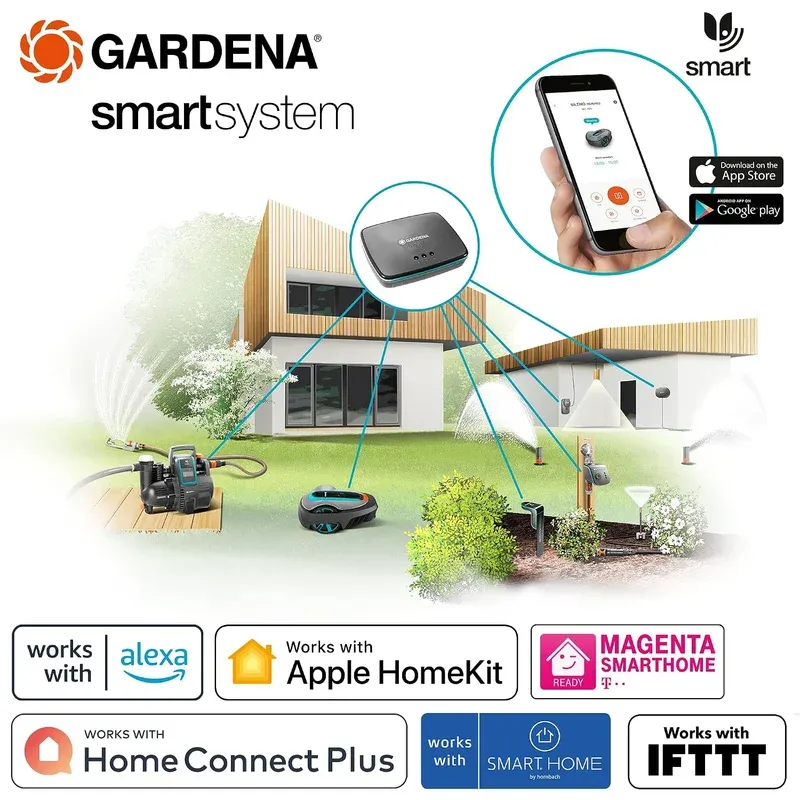
- Integrates with Amazon Alexa and Apple HomeKit through the gateway
- Optional Gardena smart Sensor adds soil moisture and weather-based skipping
The Gateway Catch
Here's the part worth reading twice. The 19032-20 has no radio of its own that reaches your phone. It pairs to the Gardena smart gateway, and that gateway is a separate purchase. Buy the controller alone and you'll have a very expensive manual timer until the gateway arrives. If you're pricing this out, budget for both from day one, plus a router within range.
Is that annoying? A little. Once the gateway is in place, though, it also serves every other Gardena smart device you own, so the cost spreads across the ecosystem rather than sitting on this one unit.
What We Own and What We Don't Know Yet
We bought the 19032-20 together with a Gardena Micro-Drip-System valve box (1255-29) and a set of Rain Bird 100-HV solenoid valves, and the order records are the full extent of what we can claim today. We haven't logged a season of watering with it, so there are no run-time figures or water-bill numbers on this page. We'd rather say that than invent them. Everything below comes from Gardena's documentation and from how 24V valve systems are wired in general.
The physical side is simple on paper: labeled terminals, low-voltage wiring, and no electrician needed for the 24V side. The 230V feed to the transformer is the only part that deserves respect. Mapping which drip lines belong to which valve, then naming them in the app, is the part that takes real planning time.
Where It Fits
This is a controller for people who already have, or plan to install, a proper valve-and-pipe irrigation layout. Pair it with the smart Sensor and it can skip a cycle when the soil is already wet or rain is forecast, which is the feature that saves water rather than just automating waste. Skip the sensor and you still get scheduled zones that you can override from your phone.
Voice control is worth a short note, because it behaves differently from what many buyers expect. Alexa and Apple HomeKit reach the controller through the gateway, not through the controller itself, so a voice command is only as dependable as the gateway, your router, and your internet connection. That suits a quick "water the beds" request or a place in a wider routine. It is a poor reason to buy the system on its own. Schedules live in the Gardena app, and they keep running as programmed even when you never speak to anything.
For a fixed, multi-zone garden, it's a level-headed pick, provided you walk in knowing the gateway is a mandatory second purchase. For a single hose on a balcony it's overkill, and a simple tap timer wins.
Budget the Whole System, Not the Box
The price on the controller's shelf tag is only the first line of the bill. You also need the Gardena smart gateway, which is sold separately, and a router with a signal that reaches it. If you want weather-aware watering you need the optional smart Sensor as well. Then come the parts that make water move: the solenoid valves, the valve box, the pipe or drip line, and the cable between them. The controller itself only switches the valves, so a cheap valve choice limits the whole system. Add the transformer feed from the 230V side and you have a realistic shopping list. Work through that list before you order, because a half-finished install leaves you with a controller that has nothing to switch and no way to reach your phone.
Planning Zones Before You Buy
A six-valve controller sounds like a lot until you start counting zones. Front beds, back beds, the lawn, a row of pots, a greenhouse drip line, and a spare run for whatever you plant next. Six fills up faster than most people expect, so size up rather than down.
Split the garden by water need, not by location. Shady beds hold moisture longer and want shorter runs, a sun-baked lawn strip wants more, and containers want something different again. One schedule blasting everything for the same ten minutes wastes water on one zone and starves another.
Label every valve wire as you connect it. Chasing an unlabeled zone months later, in a valve box, is a bad way to spend a Saturday, and ten minutes of documentation now saves it.
Frequently Asked Questions
Does the Gardena Smart Irrigation Control 19032-20 need a gateway?
Yes. The controller talks to the app through the Gardena smart gateway, which is sold separately and is not included in the 19032-20 box. Without the gateway plus a router and internet, you get no app control at all.
How many valves can it run?
Up to six 24V irrigation valves, each on its own schedule. You can build six independent watering zones and program a different run time and start time per zone.
Does it work with Alexa or Apple HomeKit?
Yes. The Gardena smart system integrates with Amazon Alexa and Apple HomeKit through the smart gateway, so you can trigger zones by voice or fold watering into wider home automations.
Can it water automatically based on soil moisture?
Only with the optional Gardena smart Sensor. On its own the controller runs schedules. Add the sensor and it factors soil moisture, temperature, and weather forecasts into whether a zone actually runs.