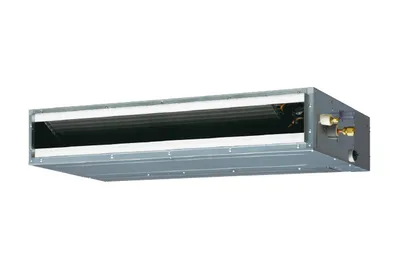
Fujitsu ARXK009GLGH: The 2.8 kW Ducted Unit We Bought for the Ground-Floor Rooms
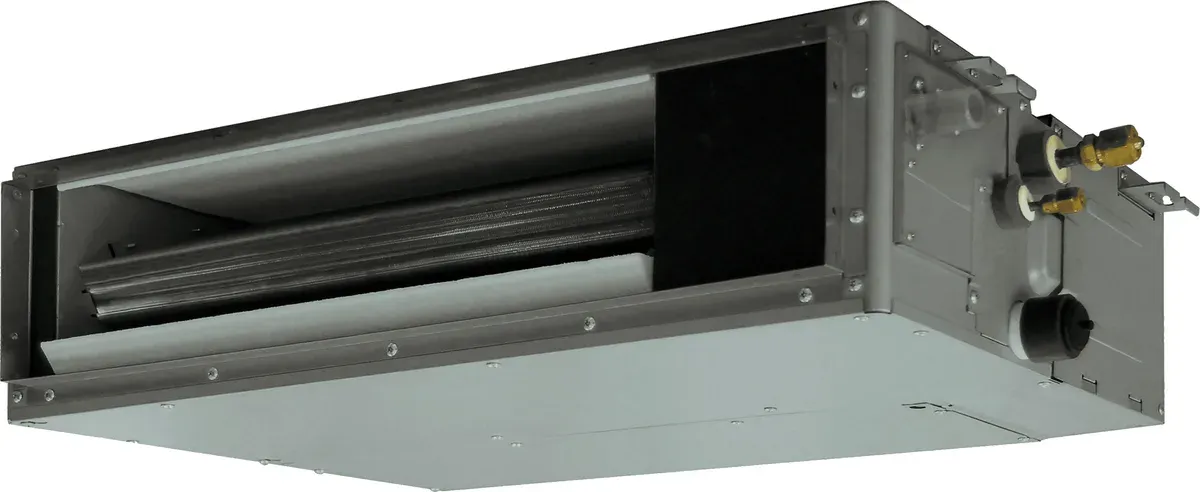
Product Details
🏭 Manufacturer: Fujitsu
🏋️♂️ Weight: 15.5 kg
📏 Dimensions: 198 x 700 x 450 mm
🆔 Model Number: ARXK009GLGH
🔧 Usage: Ducted Cooling and Heating of Single Rooms on an Airstage VRF System
The Fujitsu ARXK009GLGH is the small ducted indoor unit in our house. It's a 2.8 kW cooling, 3.2 kW heating steel box that hides above a ceiling and blows through a short duct, and it belongs to Fujitsu's Airstage VRF range, where one outdoor unit feeds several indoor units. We bought the whole climate system through an installer. Downstairs sits a mini VRF with one outdoor unit, four ducted indoor units and one split; upstairs a separate multi system with one outdoor unit and three wall units. Two outdoor units, eight indoor units, all Fujitsu. This model is the small ducted one for the ground-floor rooms. Nobody lives in the house yet. So what follows is a spec sheet with a smart home verdict, not a season of notes, and every number about the unit comes from Fujitsu General's own documents.
Does It Fit a Home Assistant House?
Honest answer first: we haven't decided how the air conditioning will talk to Home Assistant, and I won't pretend otherwise. What I can do is list what Fujitsu documents for this family, because that's what settles the question later.
The installation manual lists a wireless LAN adapter, UTY-TFSXZ series, as an optional part "for wireless LAN control". Fujitsu runs two phone apps, FGLair and AIRSTAGE Mobile, and its own page says which one you get depends on the adapter. The AIRSTAGE Mobile page describes grouping units by building, floor or room, up to five user accounts per indoor unit, weekly schedules, and voice control through a connected smart speaker. It doesn't name Google Home, and it doesn't say whether anything works without an internet connection. Read that silence the way I do: assume cloud until proven otherwise.
Home Assistant has shipped a core FGLair integration since version 2024.9. It's cloud polling, it needs the FGLair login, and its own page lists the device names it supports and the ones it excludes. It doesn't mention AIRSTAGE Mobile or VRF indoor units, so I can't promise that a ducted unit on a VRF network ever shows up there. Does that kill the idea? No. It moves it.
The move is the VRF network itself. Fujitsu sells converters that sit on the system's transmission line and expose every indoor unit to a building controller: a Modbus converter (UTY-VMGX), a KNX converter (UTY-VKGX), a BACnet gateway and a LonWorks converter. For a house that already reads its heat pump over Modbus, that's the familiar door. I wrote up that approach in Gree Versati III in Home Assistant with ESPHome Modbus, and the same logic applies here: local bus, no login, survives a router reboot. The converter costs more than a Wi-Fi dongle and needs the installer to wire it in. I'd put it on the quote anyway. Plenty of people will tell you a cloud app is good enough for air conditioning, and for a single-room split they're probably right. For eight indoor units on two systems, I don't think they are.
There's a third, humbler option on the indoor unit itself. The manual lists external connect kits: a dry-contact input and a voltage input for control, an output terminal, and two kits for a "forced thermostat off" function. A window contact wired into that input stops the unit from cooling an open room with no software in the loop at all. That's exactly the kind of interlock this house is built around, and it's the one I'd wire first.
The Hardware, Spec by Spec
Fujitsu files the ARXK series under "low static pressure duct (mini duct) type"; the UK data sheet calls the same unit a bulkhead duct. Either way it's a shallow galvanized steel box meant for a ceiling void. The family starts at the 1.1 kW ARXK004GLGH and runs up to the ARXK024GLGH, and the GLGH suffix means the version with a built-in drain pump. The GLFH twins have none.
What the Spec Sheet Says
- Capacity: 2.8 kW cooling, 3.2 kW heating at the standard rating points (27 C indoors and 35 C outdoors for cooling; 20 C indoors and 7 C outdoors for heating)
- Power supply: single-phase 230 V, 50 Hz; rated input 28 W
- Fan: two sirocco fans, 80 W motor output, six speeds
- Airflow, cooling and heating alike: 460, 440, 420, 400, 370 and 340 m3/h from High down to Quiet
- External static pressure: 0 to 30 Pa, 10 Pa as the factory setting
- Sound pressure: 26, 25, 24, 23, 22 and 21 dB(A) across the same six speeds
- Dimensions: 198 mm high, 700 mm wide, 450 mm deep; 15.5 kg net
- Refrigerant connections: 6.35 mm liquid and 9.52 mm gas, both flare
- Drain: VP25 hose, 25 mm inside, 32 mm outside; the pump lifts condensate up to 700 mm
- Refrigerant: R410A
- Filter: two washable PP honeycomb net filters
Twenty-eight watts. That's the whole electrical appetite of the indoor unit; the compressor outdoors does the real work and bills separately. The 21 dB(A) on Quiet is an anechoic chamber figure, and Fujitsu's own footnote says real rooms measure higher. I'll believe a number when I hold a meter under the grille.
The filters deserve a sentence, because a ducted unit hides them. The operation manual says to clean them every two weeks in normal use, with a vacuum cleaner or by washing, and warns that a clogged filter cuts airflow and raises noise. Two weeks. Above a ceiling. That's why the service access below matters more than it sounds.
What Static Pressure Means Here
Static pressure is the resistance the fan can push against: ducts, bends, grilles, filters. Thirty pascals is not much. This unit is designed for a short run to a nearby grille, not for a trunk duct snaking across a floor. The installer picks one of four modes with the remote controller, function number 26: 0, 10, 20 or 30 Pa, and the manual says the mode has to match the static pressure the ductwork actually presents. Need more? Fujitsu's slim duct sibling, the ARXD009GLEH, has the same 2.8 kW rating but a 0 to 90 Pa range, a 620 mm deep casing and 17 kg. Those extra 170 mm of depth are the price of longer ducts. Is a ceiling void worth 170 mm to you? That's a question for the drawings, not the brochure.
Installation Constraints Worth Knowing
The manual insists on a service access to the control box and the filter, 100 mm or more between the inlet and the ceiling, insulated ducts, and inlet and outlet grilles that can't be removed without tools. Condensate pipework needs a downward gradient of at least 1/100. The indoor unit carries its own electronic expansion valve, which initialises the moment power is applied, so the pressure test and the vacuum have to be done before anyone flips the breaker. The remote controller is optional equipment, not something in the box. A ducted unit is a construction decision, not an appliance purchase: once the ceiling closes, it's staying.
What We Actually Own
Here's the honest boundary. We bought the Fujitsu system as a whole through the installer: the ground-floor mini VRF with four ducted units and a split, and the first-floor multi with three wall units. The ARXK009GLGH is the small ducted one for the ground-floor rooms. That's the complete list of first-hand facts.
What I can't tell you: how loud 340 m3/h sounds through a real grille, what the system draws in a heatwave, whether the ducts whistle, or how the rooms feel at seven in the morning. Nobody lives there. I'd rather leave those blank than invent a diary, and I'll fill them in after the first summer.
Where It Fits in the Stack
This house hands the top layer to Home Assistant and lets each brand do its one job below it. Somfy drives the blinds, the Gree Versati III split does the floor heating, Huawei the solar, Fujitsu the air. The automations I'd want from this unit are obvious: close the blinds before the sun loads the room so the compressor doesn't have to; stop cooling when a window opens; never let the air conditioning and the floor heating argue over the same room. None of that runs today. The blinds aren't in Home Assistant yet either. Writing the rules is the easy half; getting a local, honest data path out of a VRF system is the half that decides whether the rules are worth writing.
Is this the right unit for you? If you have a ceiling void, a short duct run, and you want air conditioning that disappears, yes. If you'd rather have an app that works on day one with no installer involved, a wall unit with a Wi-Fi module is the simpler buy.
Before You Sign the Quote
Ask four things. Which outdoor unit this indoor unit hangs on, and how many siblings share it. Whether the quote says GLGH or GLFH, because only the first one has a drain pump, and that decides how condensate leaves the ceiling. Which static pressure mode the installer intends to set, and whether the duct drawing agrees with it. And which control path is included: a wired remote, a wireless LAN adapter, or a network converter, because each one sets a different ceiling on what Home Assistant will ever see.
Frequently Asked Questions
Is the Fujitsu ARXK009GLGH a split air conditioner or a VRF unit?
A VRF indoor unit. It needs an Airstage VRF outdoor unit, and the installation manual has it set an indoor unit address and a refrigerant circuit address so the outdoor unit can tell it apart from its siblings. It isn't sold as a stand-alone split, so budget for the outdoor unit and the other indoor units that share it.
How loud is the ARXK009GLGH?
Fujitsu's spec sheet lists 26, 25, 24, 23, 22 and 21 dB(A) sound pressure from High down to Quiet, for cooling and heating alike. Those are anechoic chamber values, and Fujitsu's own footnote says an installed unit measures higher because the room adds its own sound. Treat 21 dB(A) as a lab best case, not a bedroom promise.
How much ductwork can the ARXK009GLGH drive?
Not much. External static pressure is 0 to 30 Pa with 10 Pa as the factory setting, chosen from four modes on the remote controller. It is built for a short run to a nearby grille. For longer ducts Fujitsu's slim duct sibling, the ARXD009GLEH, offers the same 2.8 kW with a 0 to 90 Pa range, at the cost of a 620 mm deep casing and 17 kg.
Does the Fujitsu ARXK009GLGH work with Home Assistant?
Not out of the box. Fujitsu lists an optional wireless LAN adapter for its phone app, and Home Assistant's FGLair integration is cloud polling that doesn't mention VRF units. The local route is a Modbus or KNX converter on the VRF network, which Fujitsu sells for building controllers. In our house that choice hasn't been made yet.