Sonoff ZBDongle-E Zigbee USB Coordinator: Specs, Range and Price in 2026
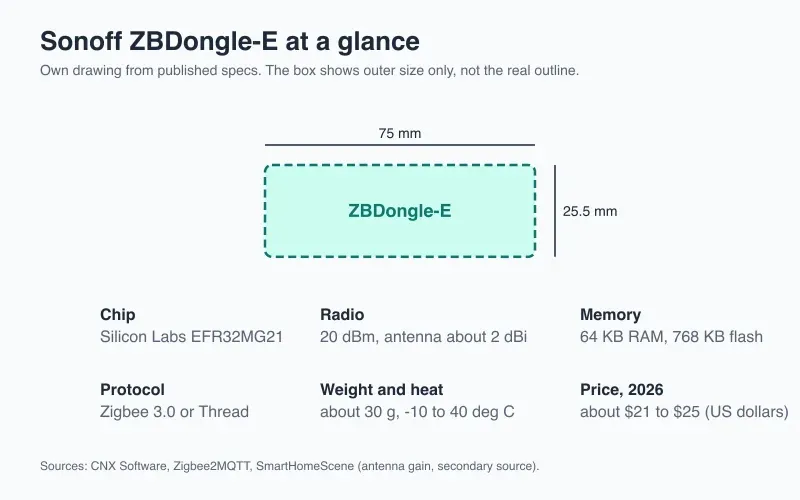
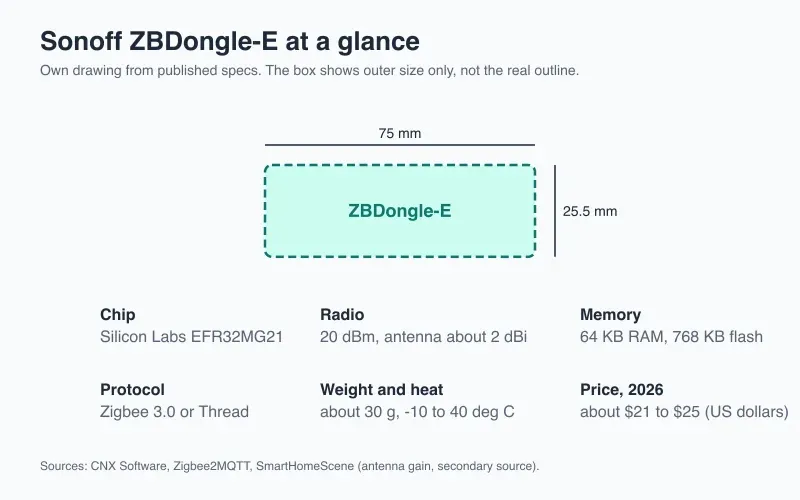
The Sonoff ZBDongle-E is a USB Zigbee 3.0 coordinator built on a Silicon Labs EFR32MG21 chip with a 20 dBm radio. In 2026 it sells for roughly $21 to $25, works with ZHA and Zigbee2MQTT, and does Thread only by giving up Zigbee.
Product Details
🏭 Manufacturer: Sonoff
🔌 Plug Format: USB 2.0 (USB-A)
🔖 Part Number: ZBDongle-E
🏋️♂️ Weight: about 30 g
📏 Dimensions: 75 x 25.5 x 13.5 mm
🆔 Model Number: ZBDongle-E
📐 Size: Compact
🎨 Style: Minimalist
🧲 Mounting Type: Portable
🔧 Usage: Connects Zigbee devices
If your house runs mostly on mains-powered Zigbee gear and you want a coordinator that doesn't cost much, the Sonoff ZBDongle-E is the stick many Zigbee guides assume you'll buy. It's old by smart home standards. It launched in 2022 at $19.90, according to CNX Software, and 2026 listings sit between about $21 and $25. So why is it still on the list?
Mostly because it does one job and does it cheaply. It's also the stick other people in the forums have debugged for years, which counts for more than a spec sheet.
A disclosure first. My own coordinator is a Home Assistant Connect ZBT-1, not this stick, so nothing here comes from a bench test of mine. What follows is a compendium: I read the manufacturer-side coverage, Zigbee2MQTT's documentation and a long owner thread, and I've marked every figure that comes from a secondary source.
What the ZBDongle-E Actually Is
It's a USB-A stick with an external antenna that turns a Home Assistant machine into a Zigbee coordinator. Inside sits a Silicon Labs EFR32MG21 system-on-chip, with 64 KB of RAM and 768 KB of flash, plus a CH9102F chip that handles the USB side. CNX Software, which covered the launch, put the radio at 20 dBm.
The name causes trouble. Sonoff sells three sticks that look nearly identical:
- ZBDongle-P: the first Dongle Plus, built on a Texas Instruments CC2652P.
- ZBDongle-E: this one, the Dongle Plus V2 on the MG21 chip.
- Dongle Plus MG24: the newest, with the MG24 chip and far more memory, covered on our Sonoff Zigbee 3.0 USB Dongle Plus page.
Retailers mix the names constantly. Check the chip in the listing, not only the colour of the case.
Specs at a Glance
| Spec | Sonoff ZBDongle-E |
|---|---|
| Radio chip | Silicon Labs EFR32MG21 |
| Memory | 64 KB RAM, 768 KB flash |
| Protocol | Zigbee 3.0; Thread only through OpenThread firmware, which drops Zigbee |
| Transmit power | 20 dBm |
| Antenna | External with an SMA connector, about 2 dBi (secondary source) |
| USB bridge | CH9102F |
| Size | 75 x 25.5 x 13.5 mm |
| Weight | about 30 g |
| Operating temperature | -10 to 40 degrees C |
| Price in 2026 | about $21 to $25 |
Sizes, memory and temperature come from CNX Software and Zigbee2MQTT. The 2 dBi antenna figure comes from SmartHomeScene's comparison, not from Sonoff's own sheet, and I couldn't load Sonoff's product page to check it. Treat it as approximate.
How Far Does It Reach?
On paper it's the loudest stick in its class. Twenty dBm is a lot of transmit power, and a Home Assistant ZBT-2 manages 10 dBm in Europe. But a Zigbee link runs both ways. The battery sensor at the far end can't answer at 20 dBm, so the coordinator shouting louder only helps up to a point.
What decides range in a real house is the mesh. Every mains-powered bulb, plug and switch relays traffic, and a battery sensor never does. On my own network most routers are simply the mains-powered devices, which is why a house full of Zigbee lighting rarely has coverage trouble. The mesh reliability notes go deeper on that.
I found no independent head-to-head range measurement of this stick against a newer one. Anyone who tells you the ZBDongle-E reaches exactly so many metres is guessing.
Placement matters more than the spec
Zigbee2MQTT says a 50 cm USB extension cable is already enough to reduce interference, and that a USB 2 port can help more than a USB 3 one. A long owner thread on the stick repeats it. So don't plug it straight into the back of a mini PC next to a Wi-Fi radio and then blame the chip.
Does It Work With Home Assistant and Zigbee2MQTT?
Yes to both. In Home Assistant it runs under the ZHA integration, and Zigbee2MQTT has a dedicated page for it. Our Zigbee2MQTT setup guide covers pairing, and the rest of our Home Assistant setup articles build on it.
There's an old caveat worth knowing about. CNX Software noted in 2022 that the MG21 wasn't recommended with Zigbee2MQTT at the time. That has aged out: Zigbee2MQTT's adapter page now lists the EmberZNet firmware family among its recommended options. Early owners did have to re-pair devices after a firmware change, so expect a short evening of re-pairing if you ever swap the firmware.
Thread: Possible, But Not Alongside Zigbee
The stick can run OpenThread RCP firmware, and SmartHomeScene says Sonoff's flasher installs it. Once you do that it's a Thread radio and nothing else. SmartHomeScene's review says there's no real reason to pick it for Thread over a newer MG24 stick, and the price arithmetic points the same way. If you want both protocols at once, the cheapest honest answer is two radios. Our Thread network setup notes and the Thread vs Zigbee vs Matter comparison explain when that's worth doing.
What Goes Wrong With It
Less than you'd fear, but it's old, and old has its own complaints.
- USB 3 ports. Zigbee2MQTT's page for the stick warns that pairing may fail on a USB 3 port.
- Antenna first. Zigbee2MQTT's instructions tell you to attach the antenna before powering the stick, to avoid burning out the radio.
- A different IEEE address. One forum poster moving to another coordinator reported that Zigbee2MQTT reset its device database to the coordinator alone, because the new stick has a different address. Plan a backup before any swap.
- The temperature ceiling. 40 degrees C leaves less headroom than some newer sticks, which matters if the machine sits in a hot cabinet. My own Home Assistant box is a Raspberry Pi 5 on a DIN rail inside a distribution board, so that line caught my eye.
Upgrade path
There's a consolation. Zigbee2MQTT documents the ZBDongle-E as a router once it's flashed with router firmware. Buy a newer coordinator later and this stick goes back to work in the mesh instead of a drawer.
Is It Worth Buying in 2026?
For a Zigbee-only house with plenty of mains-powered devices, yes. At about $21 to $25 it costs roughly half of a ZBT-2 at its $49 recommended price, and I found no measurement showing the pricier stick reaching farther on Zigbee alone.
It's the wrong pick if you want Thread alongside Zigbee on one radio, if the machine runs hot, or if you want the largest device count on a single coordinator. Memory is the limit there: the MG24 stick has 256 KB of RAM against this one's 64 KB. For those cases look at the Dongle Plus MG24, which costs roughly $8 to $15 more.
One honest note on warranty. The one comparison site that lists it gives the ZBDongle-E two years. I couldn't confirm that on Sonoff's own pages, so check the listing you buy from.
Bottom Line
The ZBDongle-E isn't exciting, and that's the point. It's a cheap, well-documented Zigbee 3.0 coordinator that has been through years of forum debugging. Buy it on a USB 2 port with an extension cable, attach the antenna before power, and put your effort into mains-powered routers instead of chasing decibels. Buy something newer only when you have a specific reason: Thread, memory, or a hot enclosure.
Frequently Asked Questions
Is the Sonoff ZBDongle-E the same as the Zigbee 3.0 USB Dongle Plus?
It is the V2 of that product line. Sonoff sold an earlier Dongle Plus with a Texas Instruments CC2652P chip, called the ZBDongle-P, and the ZBDongle-E replaced it with a Silicon Labs EFR32MG21. Sonoff's newest stick, the Dongle Plus MG24, uses the MG24 chip. The three look alike and are three different radios, so check the model name before you buy.
Does the ZBDongle-E work with Home Assistant?
Yes. It works as a coordinator with the ZHA integration and with Zigbee2MQTT. Zigbee2MQTT lists the EmberZNet firmware family, which this chip runs, among its recommended adapter types.
Can the ZBDongle-E run Thread?
Only by flashing OpenThread firmware, and then it stops being a Zigbee coordinator. If you want Zigbee and Thread at the same time you need two radios.
Why does pairing fail on my ZBDongle-E?
The most common documented cause is a USB 3 port. Zigbee2MQTT's page for the stick warns that pairing may fail there. Move it to a USB 2 port, add an extension cable of about 50 cm, and make sure the antenna is attached before you power it.
Technical References
- CNX Software - Sonoff ZBDongle-E with EFR32MG21 and +20dBm radio cnx-software.com Hardware
- Zigbee2MQTT - SONOFF ZBDongle-E zigbee2mqtt.io Documentation
- Zigbee2MQTT - Supported adapters zigbee2mqtt.io Documentation
- Smart Home Compared - ZBT-2 vs ZBDongle-E smarthomecompared.com Comparison
- Home Assistant Community - ITead Sonoff ZBDongle-E thread community.home-assistant.io Owner reports