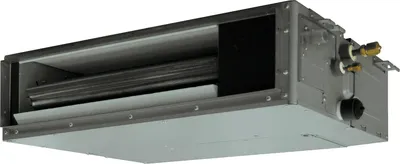
Fujitsu ARXD024GLEH: The Slim Duct Unit Behind Our Open-Plan Living Room
Product Details
🏭 Manufacturer: Fujitsu
🆔 Model Number: ARXD024GLEH
🔧 Usage: Cooling and Heating of an Open-Plan Living Room
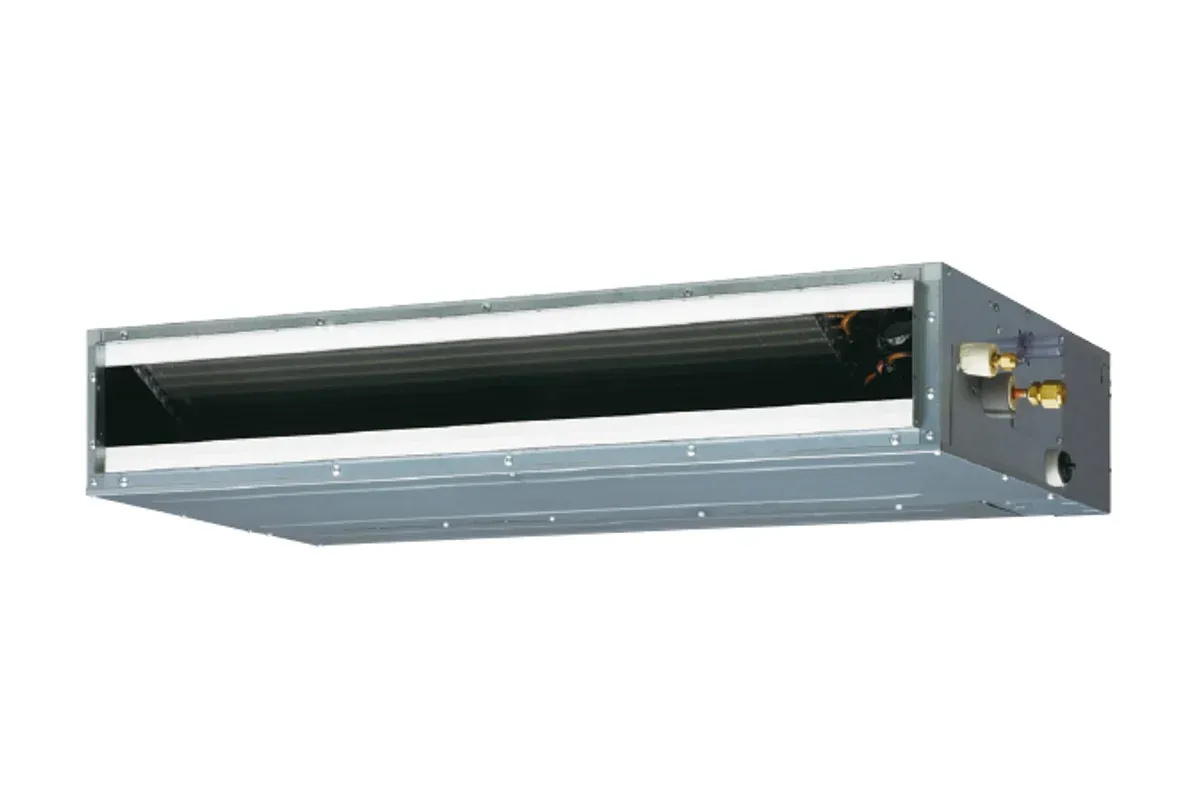
The Fujitsu ARXD024GLEH is the biggest air conditioning unit in our house. It's a slim duct indoor unit from Fujitsu's AIRSTAGE VRF lineup, rated 7.1 kW cooling and 8.0 kW heating, and it hides above the ceiling of the open-plan living room on the ground floor. You never see it. You see grilles. The house isn't lived in yet, so this page is a spec sheet with a smart home verdict, not a summer diary. Every number below comes from Fujitsu's own product page or the printed catalogue, and I'll say which where it matters.
Does It Fit a Home Assistant House?
Short answer: not by itself, and that's normal for a VRF indoor unit. The ARXD024GLEH has no Wi-Fi, no app and no network port. It talks to its outdoor unit and to a wired remote controller, and that's the whole of its social life.
So where does Home Assistant plug in? Fujitsu's own list of adapters for the VRF family names four routes: a Modbus interface (FG-RC-MBS1Z1), a KNX interface (FG-RC-KNX1Z1), a wireless LAN adapter (listed as FJ-RC-WIFI-1, with the model plate reading FG-AC-WIFI1Z1) and BACnet gateway software (UTY-ABGX). The wireless adapter is the consumer-flavoured one. Fujitsu says it needs no separate power supply, serves a single indoor unit or up to 16 group-controlled units, and gives you on/off, mode, fan speed, louver, setpoint and a room temperature readout from a phone, tablet or PC.
Then there's the third-party route. Intesis, part of HMS Networks, sells the IN775FGL gateway for Fujitsu VRF systems. It attaches to the outdoor unit's communication bus, scans for the connected indoor and outdoor units, and can be configured for Modbus TCP, Modbus RTU, BACnet/IP, BACnet MS/TP, KNX TP1 or an open ASCII protocol over Ethernet. The 64-unit licence covers up to 64 indoor and 12 outdoor units. That's building-grade kit for an eight-unit house, which tells you something about where VRF came from.
Why does Modbus TCP matter here? Because Home Assistant ships with a Modbus integration that supports TCP connections and a climate platform, so a gateway on the bus becomes a climate entity per room without a cloud account in between. That's the same logic we applied to the Gree Versati III heat pump downstairs, where an ESP32 on the controller's Modbus port does the job.
Here's the opinion you can argue with: for a VRF system, one gateway on the bus beats a Wi-Fi dongle per indoor unit every time, even at the price of a gateway. Eight dongles are eight firmware schedules and eight things to re-pair after a router change. One gateway is one.
What our house actually does about this isn't decided. Fujitsu lists the options; the installer quoted the hardware; the control layer is still an open item on our build list, and I'd rather write that than guess.
The Hardware, Spec by Spec
First, a naming wrinkle. Our paperwork calls the ARXD024GLEH a medium static pressure ducted unit. Fujitsu's product page files it under Slim Duct. The medium static models in the same lineup carry the ARXA prefix and reach higher pressures. Both names describe the same box in our ceiling, but the slim duct label is the one that matches the 50 Pa figure below, so that's the one I'll use.
What the Catalogue Numbers Say
Fujitsu rates the unit at 7.1 kW cooling and 8.0 kW heating with an input power of 122 W for the indoor side, on single-phase 230 V, 50 Hz. The ratings assume 27 C indoor and 35 C outdoor for cooling, 20 C indoor and 7 C outdoor for heating, 7.5 m of pipe and no height difference. That's a test bench, not your July.
The fan has six steps in the printed catalogue. Airflow and sound pressure are the same in cooling and heating:
| Fan step | Airflow | Sound pressure |
|---|---|---|
| High | 1330 m3/h | 35 dB(A) |
| Med-high | 1140 m3/h | 31 dB(A) |
| Med | 1020 m3/h | 29 dB(A) |
| Low-high | 900 m3/h | 27 dB(A) |
| Low | 780 m3/h | 24 dB(A) |
| Quiet | 610 m3/h | 21 dB(A) |
Fujitsu's regional product page shows a shorter three-step table for the same model, with High at 1330 m3/h and 35 dB(A) exactly as above, so the top of the range is confirmed twice. Treat the dB figures as the unit's own rating under Fujitsu's conditions. What reaches the sofa depends on the grilles, the duct lining and how far the unit sits from the room.
What 0 to 50 Pa Means for the Duct Run
External static pressure is the resistance a ducted unit's fan has to overcome to push air through the ductwork. Every metre of duct, every bend, every grille and every filter adds to it. The ARXD024GLEH is rated from 0 to 50 Pa, with 25 Pa as the standard setting. Is that a lot? No. It's a slim duct figure, meant for short runs between a ceiling void and a few grilles, which is exactly what an open-plan living room with the unit above it asks for.
Two things follow from that number. One, the installer designs the ducts around it, not the other way round; if the pressure on site ends up above what the fan can push against, airflow drops and the unit works harder for less air. Two, don't assume the figure from one Fujitsu model applies to another. The newer R32 slim duct units in the same family, such as the ARXD012HLAH, are rated 0 to 90 Pa with the same 25 Pa standard. Same chassis height, different fan envelope. Read the suffix.
Size, Weight and Connections
The unit measures 198 mm high, 1100 mm wide and 620 mm deep and weighs 26 kg. That 198 mm is the number that decides whether it fits your ceiling void at all. Refrigerant connections are flare: 9.52 mm liquid and 15.88 mm gas. The drain hose is 25 mm inside and 32 mm outside diameter. The catalogue also lists an optional EV kit for the unit; ask your installer whether your system needs it, because the answer depends on the outdoor unit and the pipework, not on this page.
What We Actually Own
Here's the honest boundary. We bought the whole climate system as one Fujitsu package through an installer. The ground floor runs a mini VRF: one outdoor unit, four ducted indoor units and one split. The first floor runs a multi system: one outdoor unit and three wall units. That's two outdoor units and eight indoor units in total, and the ARXD024GLEH is the largest of the eight. It serves the open-plan living room. That's the whole of what I can claim first-hand today.
What I can't tell you: a measured noise level at the sofa, a summer's energy use, how evenly it cools the far end of the room, or how the heating side behaves next to the floor heating in a shoulder month. Nobody lives there yet. I'd rather leave those blank than make them up, and this page gets updated after the first season.
Is 7.1 kW the right size for an open-plan ground floor? I don't know yet, and neither does anyone who hasn't run it through a summer. The installer sized it. The catalogue conditions above are what the number means. The verdict waits.
Where It Fits in the Stack
The air conditioning is one of several brand-name systems in this house. Gree heats the floor, Somfy drives the blinds, Reolink runs the cameras, Huawei turns the sun into kilowatt-hours. None of them gets to own the layer above. Home Assistant does, and for the Fujitsu units the open question is which of the routes in the first section earns that seat.
The automations worth having are easy to name and not yet built: an open window silences the living room unit, the blinds close before the afternoon sun makes the unit fight them, and the heat pump and the air conditioning never heat and cool the same floor at the same time. Each of those needs the Fujitsu side to show up as a climate entity with a mode and a setpoint, which is what a Modbus or KNX gateway provides and a bare wired controller doesn't. The Somfy blinds aren't in Home Assistant yet either, so every one of these waits its turn.
Would I pick a VRF indoor unit for a house that wants local control? Yes, with a condition. A VRF system is a bus with a documented gateway market behind it, which is a better starting position than a consumer split whose only door is a vendor cloud. The condition is that someone has to actually buy and wire that gateway, and until then the unit answers only to its remote.
Before You Sign the Quote
Ask four things:
- Which static pressure setting the installer plans to commission, and whether the duct design stays under 50 Pa with the grilles and filters you've chosen
- Where the wired remote controller will live, because that's the wall you'll stare at for years
- Which network option, if any, is on the quote, and whether it's the per-unit wireless adapter or a gateway on the bus
- How the drain runs from a unit that sits 198 mm tall in a ceiling void, because a slim unit leaves little room for a slope
Check the model suffix on the order, too. ARXD024GLEH is a specific unit with a specific pressure range, and the same four letters at the front don't promise the same fan behind them.
Frequently Asked Questions
Does the Fujitsu ARXD024GLEH work with Home Assistant?
Not on its own. It's a VRF indoor unit with no network port of its own. Fujitsu lists a Modbus interface, a KNX interface, a wireless LAN adapter and BACnet gateway software for its VRF family, and Intesis sells a gateway that sits on the outdoor unit's communication bus and speaks Modbus TCP. Home Assistant's built-in Modbus integration can talk to that. Which route our house takes isn't decided yet.
How much static pressure does the ARXD024GLEH handle?
Fujitsu rates it from 0 to 50 Pa of external static pressure, with 25 Pa as the standard setting. That's a slim duct unit for short duct runs, not a medium or high static unit. The newer R32 slim duct models in the same family go to 90 Pa, so check the suffix before you plan long branches.
How loud is the ARXD024GLEH?
The catalogue lists 35 dB(A) sound pressure on the High fan step and 21 dB(A) on Quiet, with 31, 29, 27 and 24 dB(A) on the steps between. Those are Fujitsu's rated figures for the unit itself, measured under its test conditions. The grilles, the duct lining and the room decide what you actually hear.
Can the ARXD024GLEH run as a single split?
No. It's an indoor unit from Fujitsu's AIRSTAGE VRF lineup and needs a VRF outdoor unit, which serves several indoor units on one refrigerant circuit. For one room on one outdoor unit, Fujitsu's split slim duct range is the product to look at instead.