Home Assistant ZBT-2 vs ZBT-1 vs Sonoff ZBDongle-E and MG24: Range, Specs and Price

This post may contain affiliate links. As an Amazon Associate we earn from qualifying purchases. Disclosure.
A ZBT-2 costs $49. A Sonoff ZBDongle-E costs about $21 to $25, its newer MG24 sibling about $33 to $36, and the old ZBT-1 is out of production. Here is what the spec sheets, five reviews and the owner threads say the extra money buys, whether a better antenna could close the gap, and what nobody has measured.
I'll say up front where my evidence stops. I haven't tested any of these sticks for range. The coordinator in my own house build is a ZBT-1, but the Zigbee layer there isn't a lived-in network yet, so I have no field figures to offer even for that one. This isn't a test. It's a cross-check of manufacturer pages, four reviews, a few long Home Assistant community threads and the price listings those sources quote. Prices are in US dollars and I don't name a shop, because they move week to week. Where the sources disagree I say so, because that's where buyers get burned.
Bottom line: For a Zigbee-only house with plenty of mains-powered devices, the ZBDongle-E at roughly $21 to $25 does the job, and I found no independent measurement showing the ZBT-2 reaching farther. A 4.5 dBi antenna listed for the Sonoff stick would, on paper, match the ZBT-2's antenna for what should be a fraction of the price gap, though I couldn't find its price. The ZBT-1 is the one to skip in a new build, because it's out of production. If you'd rather buy once and keep Thread open as an option, Sonoff's newer MG24 stick costs roughly $8 to $15 more than the ZBDongle-E and has an extension cable in the box. The ZBT-2 at $49 earns its premium on other things: Thread on a stick of its own, official firmware tooling, a design that keeps the antenna away from USB noise, and a newer chip with more headroom. Pay for those. Don't pay for a range promise nobody has measured.
How Do the Four Sticks Compare on Paper?
All four are USB sticks that turn a Home Assistant machine into a Zigbee coordinator, and all four use a Silicon Labs radio. The ZBDongle-E and the ZBT-1 share the older MG21 chip family, which matters later. Sonoff's Dongle Plus MG24 shares the ZBT-2's newer MG24 family. Almost everything else differs.
| Sonoff ZBDongle-E | Sonoff Dongle Plus MG24 | Connect ZBT-1 | Connect ZBT-2 | |
|---|---|---|---|---|
| Radio chip | EFR32MG21 | EFR32MG24 | EFR32MG21 | MG24 (exact part not stated) |
| Memory | 64 KB RAM, 768 KB flash | 256 KB RAM, 1,536 KB flash | not stated | not stated |
| Protocols | Zigbee 3.0; Thread only via OpenThread firmware, which drops Zigbee | Zigbee 3.0 by default; OpenThread and MultiPAN firmware can be flashed | Zigbee 3.0 or Thread by firmware; multiprotocol experimental, not recommended | Zigbee 3.0 or Thread, one at a time |
| TX power | 20 dBm | up to 20 dBm (CNX prints dBi) | up to 20 dBm | 10 dBm in the EU, 8 dBm elsewhere |
| Antenna | external, about 2 dBi (secondary sources) | external SMA, 3 dBi, upgradeable to 4.5 dBi | small internal antenna, gain not published | 4.16 dBi omnidirectional, on a stand with a ground plane |
| USB bridge | CH9102F | CP2102(N) | CP2102N | ESP32-S3, 460,800 baud |
| Plug | USB-A, straight into the port | USB-A, 1 m extension cable in the box | USB-A stick, extension cable included | USB-C, 1.5 m cable included |
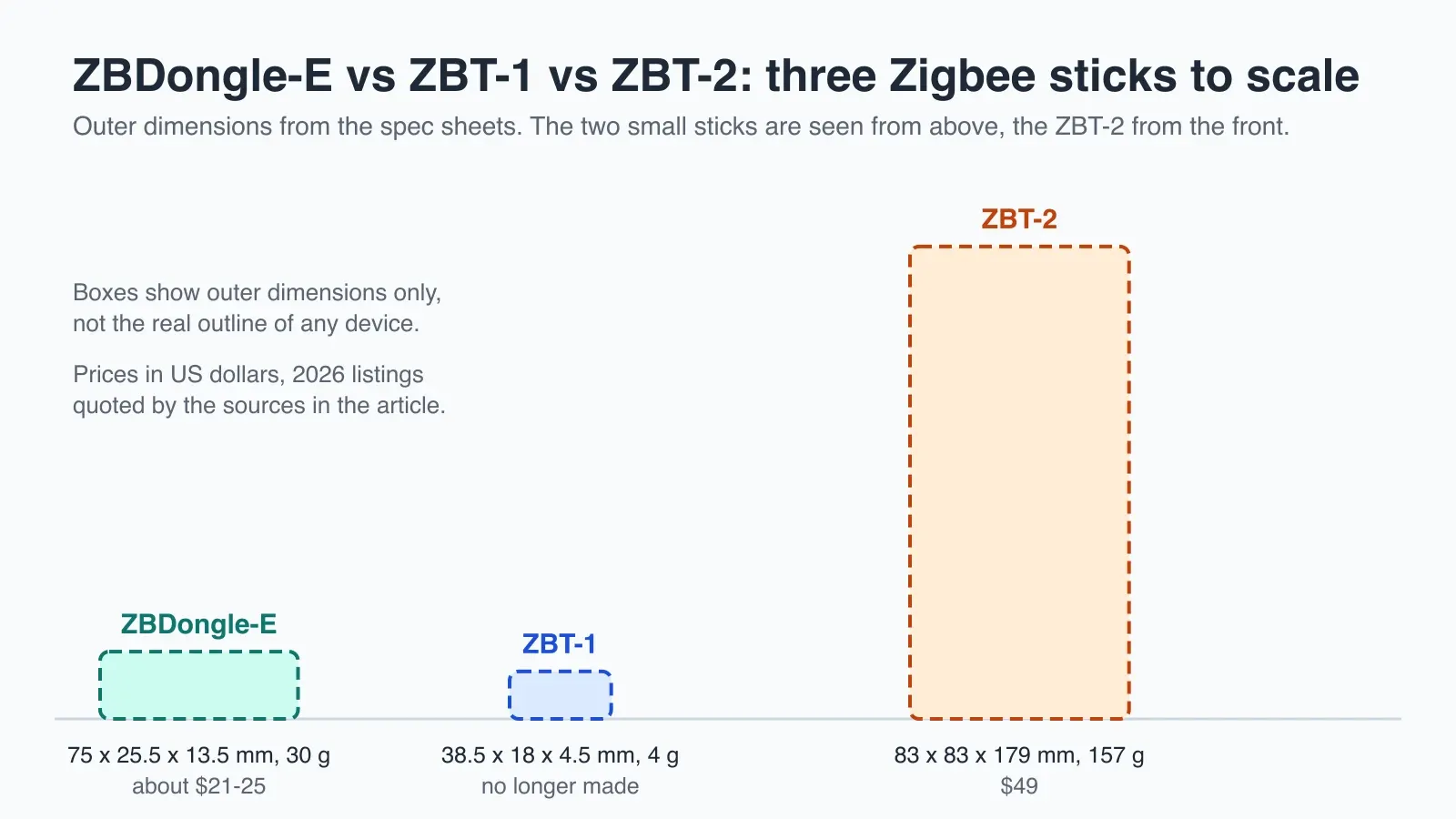
| Size and weight | 75 x 25.5 x 13.5 mm, about 30 g | stick plus antenna 214 mm long (CNX), weight not stated | 18 x 38.5 x 4.5 mm, 4 g | 83 x 83 x 179 mm, 157 g |
| Operating temperature | -10 to 40 degrees C | -10 to 40 degrees C (CNX; another source says 60) | not stated | 0 to 65 degrees C |
| Status | on sale | on sale, launched September 2025 | production ended, software updates continue | on sale |
| Price in 2026 | about $21 to $25 | about $33 to $36 | no longer made, so leftover or used stock | $49 recommended price |
Two specs deserve a second look. The ZBT-2 stands 179 mm tall, which rules out hiding it in a cramped cabinet. And the ZBDongle-E's 40 degree ceiling leaves less headroom than the ZBT-2's 65. My own Home Assistant machine is a Raspberry Pi 5 on a DIN rail, so that second line caught my eye. Sizes and ratings come from the Home Assistant ZBT-2 page, the ZBT-1 page and two CNX Software write-ups, one of the ZBDongle-E and one of the MG24 stick. The memory row is the MG24 launch claim of 300% more RAM and 100% more flash than the ZBDongle-E.
Which One Has More Range?
This is the question that started the whole comparison, and the honest answer has three layers.
What Do the Spec Sheets Say?
On paper the ZBDongle-E is the loudest. Its rated transmit power is 20 dBm, and so is the ZBT-1's ceiling. The ZBT-2's is 10 dBm in Europe and 8 dBm elsewhere, according to Home Assistant's own page. The ZBT-2 has the bigger antenna: 4.16 dBi against roughly 2 dBi for the ZBDongle-E, a figure that comes from SmartHomeScene and one comparison site. Sonoff's MG24 stick quotes up to 20 dBm and ships with a 3 dBi antenna. CNX Software prints that power in dBi, which is probably a typo for dBm, so I treat it as 20 dBm. The ZBT-1 has a small internal antenna and Home Assistant publishes no gain for it. Add transmit power and antenna gain where both exist and you get this.
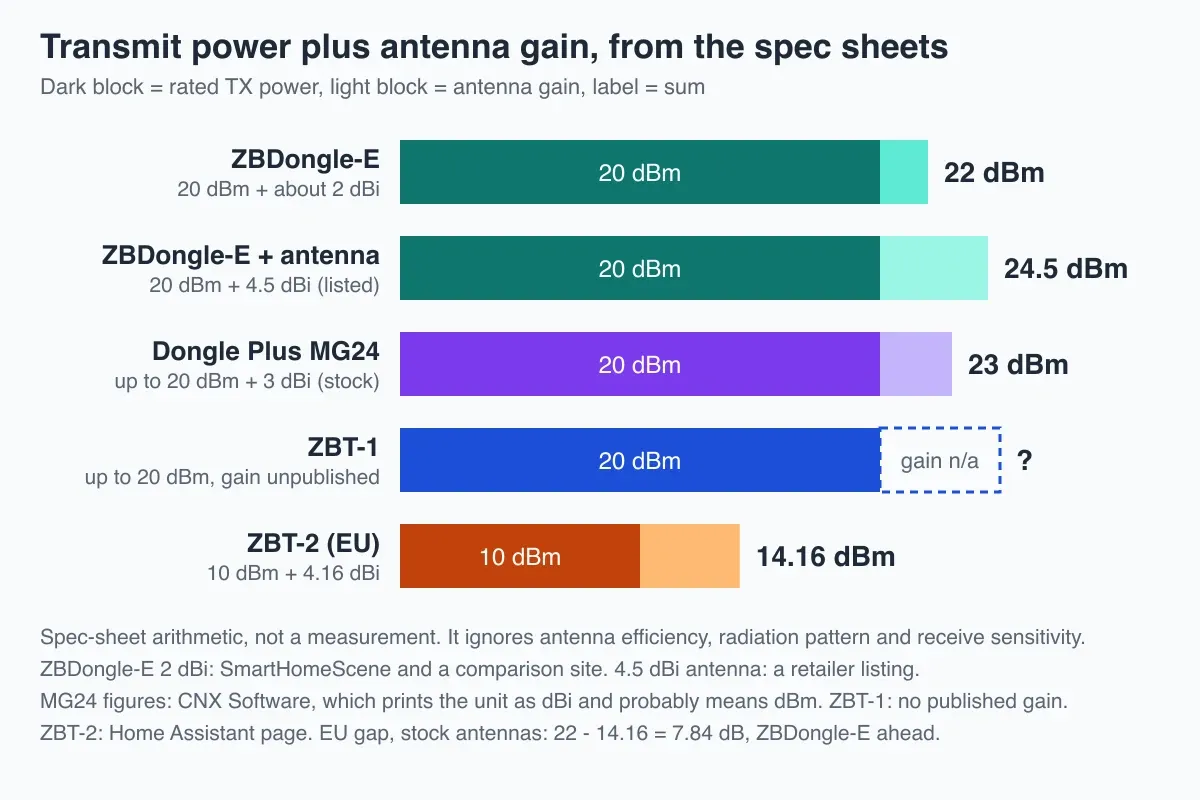
That's a 7.84 dB gap on the sending side in the EU, in the ZBDongle-E's favour, with stock antennas. Does it mean the ZBDongle-E reaches farther? Not by itself. A Zigbee link runs both ways, and the battery sensor at the far end can't shout back at 20 dBm. Zigbee2MQTT's range guide says as much in its own words: raising a coordinator's transmit power can cause weird behavior, where responses from an end device don't reliably reach the coordinator. A loud coordinator can reach a sensor that can't answer.
The ZBT-2's argument is about listening. Home Assistant's launch post says the MG24 chip has better sensitivity to weak signals than the ZBT-1's MG21. The ZBDongle-E is also an MG21, though on a different board, so treat that as a hint, not a result.
What Did Anyone Actually Measure?
Almost nothing, and I looked. I found no independent range test of these sticks side by side. What exists is a ladder of weaker evidence:
-
Home Assistant's own map. The launch post shows one network before and after, with about a 60% increase in direct connections, and calls it "Not science." The comparison was ZBT-2 against ZBT-1, not against the ZBDongle-E. The post describes the ZBT-1's antenna as pin-sized and the ZBT-2's as spoon-sized.
-
SmartHomeScene's LQI check. The review found link quality within 5 points of an SLZB-06M, which is also an MG21 design. The author calls it not lab-level evidence, puts the ZBT-2 on par with or slightly better than other MG21 and MG24 coordinators, and concludes that most homes under 100 devices will see little difference.
-
MightyGadget's impressions. Devices at the edge of the property responded fast and a sensor in a car on the street stayed connected. That review compared the ZBT-2 with Sonoff's PoE dongle, not the ZBDongle-E.
-
CNX Software's MG24 walk test. A reviewer ran the MG24 stick with ZHA on a Raspberry Pi 4, walked around the house and the street, and lost one sensor at about 40 m, with a last reading of -103 dBm. It was a review sample from Sonoff, one sensor, and nobody repeated the walk with another stick, so it says the MG24 works, not that it beats anything.
One trap if you test it yourself: don't compare LQI numbers across chips. Sonoff publishes a post about owners who upgraded from a ZBDongle-E to an MG24 dongle and watched their LQI drop. I couldn't load its full text, so I only know the conclusion from a summary: MG24 adapters report lower LQI than MG21 ones. It's a vendor's claim about its own product. Still, compare signal strength at the same spot with the same device, and don't trust the LQI column alone.
Does Antenna Position Matter More Than the Numbers?
Probably. Zigbee2MQTT says a 50 cm USB extension cable is already enough to reduce interference, and that a USB 2 port can help more than a USB 3 one. A long owner thread on the ZBDongle-E repeats the same advice. Home Assistant admits in its launch post that small sticks pick up noise from USB ports and nearby electronics, and that ZBT-1 owners were told to use an extension cable. Its ZBT-1 page still says so, and the cable ships in the box.
Now look at what the ZBT-2 actually is. A stand that acts as a ground plane, an antenna on top, and a 1.5 m cable in the box. A good part of what the ZBT-2 sells is the extension cable arrangement, built in. You can buy a chunk of that back for a ZBDongle-E with a cable and a free USB 2 port. How much of the gap that closes? I can't tell you, and nobody I read has measured it either.
What about the mesh itself? A forum poster in the ZBT-2 thread argues that mesh quality depends on the number and placement of routers, not primarily on the coordinator antenna. An older ZBDongle-E post says the same: add mains-powered routers, don't just add battery devices. Mine should end up as dozens of devices, with a good share of them mains-powered bulbs and switches that act as routers. For a network like that I'd file coordinator range under nice-to-have. My piece on Zigbee mesh reliability has the router arithmetic, and the channel planner shows which channels stay clear of Wi-Fi.
Can a Better Antenna Close the Gap on the ZBDongle-E?
This is the cheapest idea in the whole comparison, so I chased it. Several sources describe the ZBDongle-E with an SMA connector for an external antenna, and Zigbee2MQTT's own instructions for the stick tell you to re-attach the antenna before powering it, to avoid burnout. SmartHomeScene calls it a fixed 2 dBi antenna. Most of the evidence says the antenna screws on, and Sonoff's own MG24 stick comes with a 3 dBi SMA antenna that CNX Software says is upgradeable to 4.5 dBi, which only makes sense if it can be swapped. One source says otherwise for the ZBDongle-E, so look at the unit before you buy anything.
A retailer I found lists a 4.5 dBi, 2.4 GHz antenna with an RP-SMA connector, 151.5 mm long, as intended for the ZBDongle-P, the ZBDongle-E and Sonoff's MG24 stick. I couldn't find it on Sonoff's own site, and I couldn't find a price. So what I can say is conditional. The price gap between the two sticks is about $24 to $28. If the antenna costs less than that, which I'd expect from a small passive part but couldn't confirm, you'd have this on paper: 4.5 dBi against the ZBT-2's 4.16 dBi, with the ZBDongle-E's 20 dBm behind it.
Three cautions apply.
- Connectors. SMA and RP-SMA look alike and don't mate. The listing says RP-SMA, while CNX Software says only SMA. Check which one your stick has.
- Gain works both ways, in theory. A better antenna should help the stick hear as well as talk, which is the half the transmit-power numbers miss. That's general antenna theory, not something the sources tested.
- Higher gain isn't free. A higher-gain omnidirectional antenna tends to flatten its pattern, which can hurt coverage between floors, and 4.5 dBi is a listed peak, not a promise. Orientation matters.
So I read the antenna swap as the best budget experiment in this comparison. I also found nobody who has run it and reported the result.
Is the ZBT-2 Worth the Extra Money?
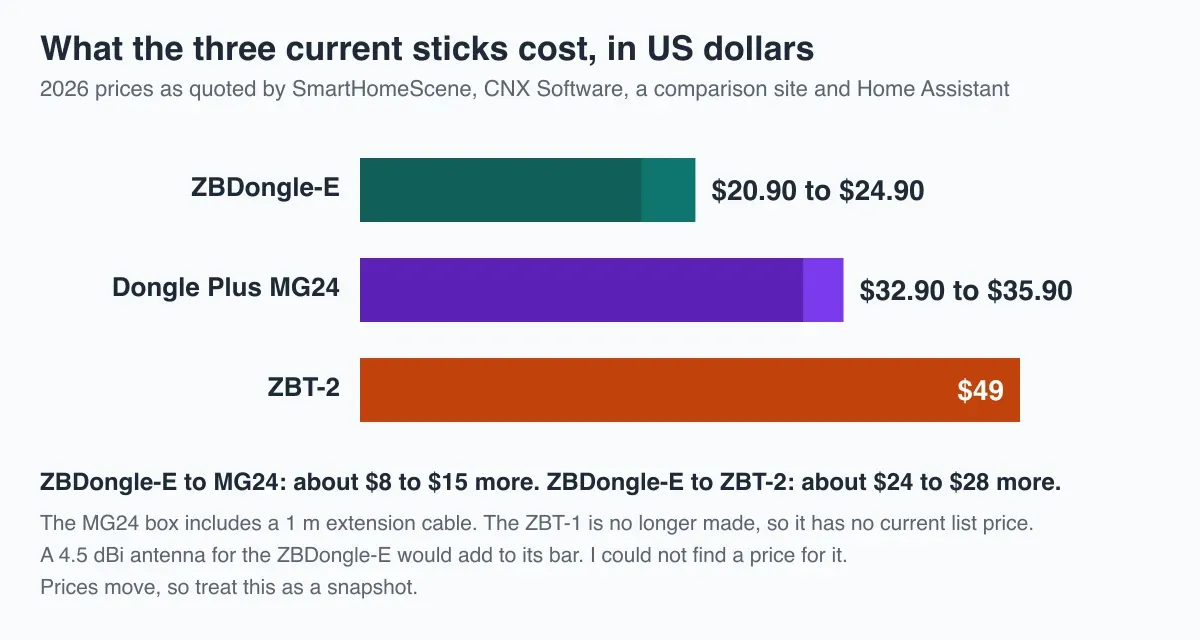
At the prices those sources quote, the ZBT-2 costs roughly twice as much as the ZBDongle-E, or a little more. Prices move, and I'd rather give you a range than a shop. The ZBDongle-E launched at $19.90 in 2022 according to CNX Software, and 2026 listings sit between about $21 and $25. The ZBT-2's recommended price is $49.
Set the sticker price aside. What does the extra money really buy? Three things hold up in the sources.
First, a newer chip. SmartHomeScene says the MG24 supports roughly double the end devices before hitting chip limits, and that most homes under 100 devices won't notice. Second, official support: a start-up wizard with one-click firmware updates and migration tools that Home Assistant says it tested with ZHA, Zigbee2MQTT and the Thread border router software. Third, Thread, which I'll come back to.
What it doesn't buy: a longer warranty (the one comparison site that lists it gives the ZBDongle-E two years and the ZBT-2 one), a Power over Ethernet option (there isn't one), or multiprotocol.
The middle option is Sonoff's own Dongle Plus MG24. It has the MG24 chip the ZBT-2 uses, 256 KB of RAM against the ZBDongle-E's 64 KB, and CNX Software listed it at $35.50 at launch in September 2025 and at $32.90 to $35.90 on Sonoff's own stores in 2026. That's roughly $8 to $15 more than the ZBDongle-E, and about $13 to $16 less than the ZBT-2. The box holds a 1 m extension cable and a 3 dBi antenna, so the cable the ZBDongle-E would make you buy is already there. What the MG24 stick lacks is the ZBT-2's official support and its stand.
What Do Owners Report Going Wrong?
Every product has a complaint thread. The question is what kind.
What Goes Wrong With the ZBT-2?
The ZBT-2 is new, and the threads show it. One poster counts about a dozen users with firmware installation failures and links a thread titled "ZBT-2 Error - Zigbee firmware failed to install." I couldn't verify the count. The same poster says the LED control entity disappears after a firmware update and a status sensor is missing, comparing it with Home Assistant's Z-Wave stick. MightyGadget found the LED doesn't light in Thread mode and that the shipped firmware wasn't the latest.
Migration is the other cluster. Home Assistant says most adapters move over with a few clicks. One field report in the forum says Zigbee2MQTT reset its device database to just the coordinator after the switch, because the new coordinator has a different IEEE address. One owner in the tag's threads reported routing failures after moving from a ZBDongle-P and went back. These are single reports, not a measured failure rate. A 2023 poster on the ZBDongle-E thread gave advice that still applies, which is to take a network backup before touching firmware.
What Goes Wrong With the ZBT-1?
It has aged out, and it had a bad start. Home Assistant says the ZBT-1 is no longer in production, though it still gets software updates, and names the ZBT-2 as its successor. A faulty part in the first batch, sold from June to October 2024, can make the stick fail in certain USB-A ports. Home Assistant runs a free replacement program for 60 months from 2 October 2024, with proof of purchase, and SkyConnect-branded units are unaffected. Multiprotocol now reads as experimental and not recommended on the product page.
The range story is the interesting one. The ZBT-1 shares the ZBDongle-E's chip family and a 20 dBm ceiling, but has a small internal antenna, and USB 3 ports make it worse, which is why the extension cable ships with it. If range is weak on a ZBT-1, the antenna and the placement are the suspects, not the chip. That's my inference from the specs, not something a source states.
What Goes Wrong With the MG24 Stick?
It's the newest of the four, launched in September 2025, so the track record is short. CNX Software's own setup test went smoothly in ZHA. Three caveats stand out. Sonoff's post about the LQI drop (above) means your link-quality column will look worse than it did on an older stick, even if range doesn't change. A reader comment under CNX Software's launch article says the coordinator IEEE overwrite trick didn't work when moving from another controller, and one comment isn't a test, but it echoes the migration reports for the ZBT-2. And the sources disagree on the operating temperature: CNX Software gives -10 to 40 degrees C, while SmartHomeScene lists 60. Sonoff also says the antenna rotates up to 180 degrees and shouldn't be forced past that.
What Goes Wrong With the ZBDongle-E?
Less, but it's old, and old has its own problems. CNX Software noted in 2022 that the MG21 wasn't recommended with Zigbee2MQTT at the time. Today Zigbee2MQTT's adapter page lists EmberZNet, the Silicon Labs firmware family, among its recommended ones, so that warning has aged out. Early owners had to re-pair devices after a firmware change. The remaining complaint is USB 3: Zigbee2MQTT's documentation for the stick warns that pairing may fail on a USB 3 port.
The ZBDongle-E also has a trick the ZBT-2 lacks. Zigbee2MQTT documents it as a router once flashed with router firmware. Buy a ZBT-2 later, and the old stick goes back to work in your mesh instead of a drawer. (The ZBT-2 has experimental repeater firmware too, but that firmware means it can't coordinate until you reflash it.)
Thread and Matter: The Better Reason to Pay More
If you want Thread, this is where the ZBT-2 stops being a luxury. It's built to run either protocol, and Home Assistant's firmware toolbox flashes the stock images. But only one at a time. Home Assistant says it tested running both together and found it just doesn't work well, and it doesn't plan simultaneous support. So one ZBT-2 is a Zigbee coordinator or a Thread border router. For both protocols you need two radios. My Thread setup notes and the Thread vs Zigbee vs Matter comparison cover when you'd want that.
The ZBDongle-E doesn't do Thread out of the box. It can run OpenThread RCP firmware, but then it stops handling Zigbee, and SmartHomeScene says Sonoff's flasher installs it and calls the stick able to handle sizeable Thread networks. The same review says there's no real reason to pick the ZBDongle-E for Thread over a newer MG24 stick. Sonoff's MG24 stick ships with Zigbee coordinator firmware and, per CNX Software, can be flashed with OpenThread RCP or MultiPAN firmware. Home Assistant doesn't recommend running both protocols on one radio.
Here's the arithmetic nobody does. Two ZBDongle-E sticks cost roughly $42 to $50, and a ZBDongle-E plus an MG24 stick for Thread about $54 to $61. One ZBT-2 costs $49. I haven't seen Home Assistant's own documentation bless a ZBDongle-E as a Thread radio, and that route leans on Sonoff's firmware, so it's the tinkerer's route, and the money advantage is thin at those prices, or gone. For most people the ZBT-2 is the cleaner way to get Thread.
Who Should Buy Which?
Here's where I land, and you can disagree.
- Zigbee only, lots of mains-powered devices, tightest budget: the ZBDongle-E, on a USB 2 port with an extension cable. If range turns out to be thin, try the antenna swap before you spend more.
- Zigbee now, Thread maybe later, and you want to buy once: Sonoff's MG24 stick. It costs roughly $8 to $15 more, the extension cable is in the box, and it has the newer chip. Its track record is shorter, so it's the pick for people who don't mind being early.
- Zigbee plus Thread or Matter over Thread: a ZBT-2 for the Thread side, or a second stick. Don't expect one ZBT-2 to do both.
- A network you expect to grow past 100 devices: an MG24 coordinator, the ZBT-2 or Sonoff's MG24 stick, because the chip has more room.
- A first Home Assistant build where support matters: the ZBT-2. The wizard and the official firmware tool are real conveniences, and $49 is the recommended price.
- You already own a ZBT-1: keep it, use the extension cable and a USB 2 port. Nothing I read says range alone justifies the swap. Don't buy one new.
On Zigbee alone, the ZBT-2's extra cost buys tidiness, not proven range.
I'd stand behind that quote, and it's the opinion a reader could argue with. The ZBT-2 is a better-finished product than the ZBDongle-E, and Thread is a real reason to own one. But the Zigbee range advantage rests on spec-sheet arithmetic, one unscientific network map and a few friendly reviews. When someone measures them all in the same house with the same devices, I'll rewrite this section. Until then, the extra $24 or so is better spent on a router, or on an antenna test, than on a promise. Prices and firmware change, so check the current listings and the Home Assistant pages before you order. If you're still choosing a coordinator, my Zigbee hub roundup covers the wider field, and the Yellow vs Green vs DIY guide covers the machine it plugs into.
Frequently Asked Questions
Should I buy the Sonoff MG24 dongle or the ZBDongle-E?
For Zigbee alone the ZBDongle-E is the cheaper, longer-proven choice. The MG24 dongle costs roughly $8 to $15 more, but it has the newer chip, 256 KB of RAM against 64 KB, a 3 dBi antenna that Sonoff says can be upgraded to 4.5 dBi, and a 1 m extension cable in the box, which the ZBDongle-E would need you to buy. I'd pick the MG24 stick if you may add Thread later.
Does the ZBT-2 have more range than the ZBDongle-E?
I found no independent head-to-head measurement. On paper the ZBDongle-E transmits harder (20 dBm against 10 dBm in the EU) and the ZBT-2 has the bigger antenna (4.16 dBi against about 2 dBi). Reviewers who used the ZBT-2 describe it as on par with, or slightly better than, other modern coordinators, not clearly better. Router placement matters more than either stick.
Can I give the ZBDongle-E a better antenna?
Most sources say it has an SMA connector for an external antenna, and one retailer lists a 4.5 dBi RP-SMA antenna as intended for it. One reviewer calls the antenna fixed, and I found no price for the antenna, so check the connector type on your unit before buying. Never power the stick without its antenna attached.
Is the ZBT-1 still worth buying?
Not for a new build. Home Assistant says it is no longer in production, names the ZBT-2 as its successor, and calls multiprotocol on it experimental and not recommended. It uses the same MG21 chip family as the ZBDongle-E but with a small internal antenna, so it needs its extension cable. If you already own one, the sources give no range reason to swap.
Can one ZBT-2 run Zigbee and Thread at the same time?
No. Home Assistant says the ZBT-2 runs one protocol at a time, and that its own tests of running both together found it just doesn't work well. You choose Zigbee or Thread firmware. For both protocols you need two radios.
Can I move a Zigbee network from a ZBDongle-E or ZBT-1 to a ZBT-2?
Home Assistant says most adapters migrate with a few clicks using its migration tools, and it tested ZHA and Zigbee2MQTT. One owner reported that Zigbee2MQTT reset its device database to just the coordinator after a switch. Back up before you move, and expect to wait for devices to reconnect.
Do I need a USB extension cable?
Zigbee2MQTT says a 50 cm extension cable is already enough to reduce USB interference, and that a USB 2 port can help more than a USB 3 one. The ZBT-1 ships with an extension cable and the ZBT-2 with a 1.5 m cable, both for the same reason.
Sources & References
- Home Assistant - Connect ZBT-2 product page and specifications home-assistant.io Documentation
- Home Assistant - Connect ZBT-1 product page and specifications home-assistant.io Documentation
- Home Assistant blog - The best gets better, Home Assistant Connect ZBT-2 home-assistant.io Documentation
- CNX Software - Sonoff ZBDongle-E with EFR32MG21 and +20dBm radio cnx-software.com Review
- CNX Software - SONOFF Dongle Plus MG24, a Zigbee/Thread USB dongle on the SiLabs EFR32MG24 cnx-software.com Review
- CNX Software - Getting started with the SONOFF Dongle Plus MG24 in Home Assistant cnx-software.com Review
- CNX Software - Home Assistant Connect ZBT-2 Zigbee and Thread USB adapter cnx-software.com Review
- SmartHomeScene - Home Assistant ZBT-2 Zigbee and Thread coordinator review smarthomescene.com Review
- SmartHomeScene - Every Sonoff dongle compared smarthomescene.com Review
- MightyGadget - Home Assistant Connect ZBT-2 review mightygadget.com Review
- Smart Home Compared - ZBT-2 vs ZBDongle-E smarthomecompared.com Review
- Zigbee2MQTT - Improve network range and stability zigbee2mqtt.io Documentation
- Zigbee2MQTT - Supported adapters zigbee2mqtt.io Documentation
- Zigbee2MQTT - SONOFF ZBDongle-E as a router zigbee2mqtt.io Documentation
- Sonoff - Upgraded from ZBDongle-E to Dongle-PMG24 or Dongle-M, but the LQI became much lower sonoff.tech Manufacturer
- Home Assistant Community - ITead Sonoff ZBDongle-E thread community.home-assistant.io Community
- Home Assistant Community - The best gets better, Home Assistant Connect ZBT-2 community.home-assistant.io Community
- Home Assistant Community - ZBT-2 migration field report community.home-assistant.io Community
- Home Assistant Community - zbt-2 tag community.home-assistant.io Community