What the Internet Actually Knows About the PineVoice

This post may contain affiliate links. As an Amazon Associate we earn from qualifying purchases. Disclosure.
Pine64's PineVoice is a $50 RISC-V smart speaker with open firmware, local wake word detection, and native Wyoming protocol support for Home Assistant. I don't own one, so this is desk research done properly: every spec cross-checked against the official docs, every launch article compared, and every contradiction named instead of smoothed over.
Quick take: The Pine64 PineVoice is a $49.99 RISC-V smart speaker built for Home Assistant: dual mics, local wake word detection, Wyoming protocol out of the box, and open factory firmware. Pine64 itself calls it early-stage, and no independent measurements exist yet. This article collects and cross-checks everything published about it so far, so you don't have to.
Let me be upfront: I don't have a PineVoice. Nobody sent me one, and this site's testing policy says openly that not every product passes through our hands. What I do have is a house whose automations run locally on a Raspberry Pi 5 with Home Assistant OS, mounted on a DIN rail in the main cabinet, while daily voice commands go through a Google Nest Mini and a Nest Hub Max. I've used both for years in my flat, and the plan is to add more of them room by room in the house. That split bugs me a little: automation is local, voice needs the internet. So when a $50 open-firmware voice satellite appeared, I read everything published about it. This is that research, organized so you can skip the reading.
What Exactly Is the PineVoice?
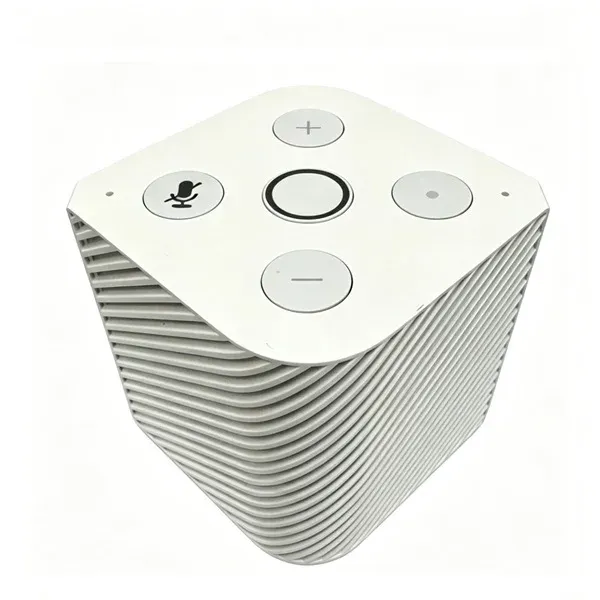
The PineVoice is a compact 65 x 65 x 66 mm cube that does one job: listen for a wake word, capture your command, and hand it to your Home Assistant server for processing. It is not an Alexa competitor with its own cloud brain. It's deliberately the opposite, a thin client for a voice pipeline you own. It's FOSS framed it as a Home Assistant powered alternative to the Amazon Echo, and per the same article the device is "built specifically as a voice satellite for Home Assistant and not a general-purpose smart speaker." OMG Ubuntu adds a nice piece of history: the project was previously known as PineVox, and the launch post's headline pitched it squarely at "Home Assistant tinkerers."
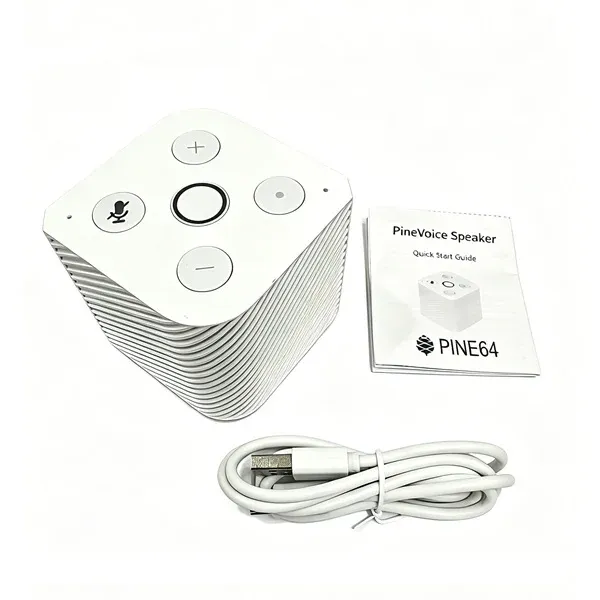
Product photo: Pine64 store.
What the Spec Sheet Says, Verified
Every line below is checked against the official Pine64 documentation and the store listing, not copied from someone's launch post:
- Bouffalo Lab BL606P SoC with three RISC-V cores: a 64-bit T-Head C906 at 480 MHz, a 32-bit E907 at 320 MHz, and a small E902 at 150 MHz
- 32 MiB of pSRAM, 788 KiB of SRAM, and 16 MiB of flash
- Dual microphone array plus a built-in speaker tuned for voice
- Top plate with volume buttons, a center LED ring button, and a hardware mic mute button with its own indicator
- WiFi 802.11 b/g/n and Bluetooth 5.2, with a single USB-C port for power and data, plus a debug UART exposed on unused USB-C pins
- $49.99 community price at the Pine64 store, $59.99 retail, 30-day warranty
Two corrections to what circulates online. First, several summaries mention only two cores; the official spec sheet lists three. Second, the mute control is a button with an LED, not a slide switch, despite Liliputing's "mic kill switch" headline. It still cuts the mics at the hardware level, which matters: a physical control you can verify is a different class of privacy feature from a software toggle.
Who Did the Real Reporting?
Here's my honest read of the coverage, and you're welcome to disagree: CNX Software is the only outlet that did reporting rather than transcription. Most launch posts trace straight back to Pine64's announcement with a fresh headline on top. CNX pulled the Bouffalo Lab datasheet, noticed the BL606P also carries an 802.15.4 Zigbee radio that Pine64's spec sheet never mentions, and flagged the most awkward software fact in the room: the default firmware implements Wyoming Satellite "which, according to the project itself, is now deprecated," with ESPHome now the preferred satellite protocol. Its verdict was that the PineVoice "should probably be considered as a smart speaker devkit" rather than a consumer device.
Liliputing contributed the most practical caveats: wake word detection is "currently a little iffy, and may struggle with some accents," and Bluetooth speaker functionality isn't available yet despite the radio being there. It's FOSS documented the wake word stack itself, noting detection runs locally through MicroWakeWord, and warned the device "might have some snafus" this early. That's three independent outlets and one manufacturer all pointing the same direction. When does that ever happen with a product launch?
Where the Sources Contradict Each Other
This is the part marketing pages never give you, and it's exactly what desk research is for.
The Memory Question: 16 or 32?
Pine64's documentation and store listing both say 32 MiB of pSRAM. CNX Software's spec rundown lists 16 MB of embedded pSRAM, consistent with Bouffalo Lab's own BL606P materials. Nobody has published a teardown that settles whether the extra 16 MiB exists on a separate die or whether one side simply has the number wrong. For a chip whose wake word model lives entirely in that memory, the doubling isn't trivia.
The Firmware Source Trail
At launch, CNX wrote that it couldn't find the default firmware's source code. The Pine64 wiki now states the PineVoice SmartSpeaker SDK is published on Codeberg and GitHub, and OMG Ubuntu identified the base as Alibaba's open-source YoC platform. So the openness claim went from unverifiable in June to checkable today. That's the right direction, but it also means any article written at launch, including the early version of this one, described a promise rather than a fact.
Smaller Cracks Worth Knowing
- The wake word engine and the "Hey Jarvis" model are documented only on the wiki; the main documentation site never names them. The wiki states: "For now, PineVoice uses the 'Hey Jarvis' model from the ESPHome MicroWakeWord models project."
- Pricing spreads fast outside the Pine64 store: ameriDroid lists the same unit at $64.95, thirty percent above community price.
- The Zigbee radio inside the SoC appears in CNX's spec table and nowhere in Pine64's. Unexposed silicon, or a future feature? No source says.
Every PineVoice launch post traces back to the same press release. The real review of this speaker has not been written yet.
How It Talks to Home Assistant
The integration story reads as the cleanest part of the whole product. The firmware implements the Wyoming protocol, which the Home Assistant Wyoming integration already supports, so the PineVoice should appear like any other voice satellite. WiFi provisioning happens over Improv BLE from a phone or browser, no serial cables required.
The documented flow: the wake word model fires locally, the device streams your speech to your Assist pipeline, Whisper transcribes it, your automations run, and Piper speaks the answer back. Everything stays on your LAN. The satellite is the cheap part of that chain; resellers explicitly note you need a running Home Assistant instance with Assist configured, and speech-to-text is where the server actually works. Budget for the brain before you multiply the mouths.
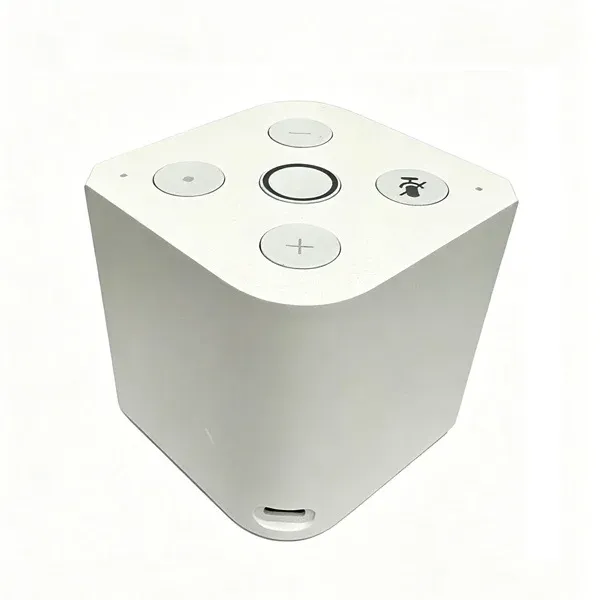
Product photo: Pine64 store.
PineVoice vs Home Assistant Voice PE
The obvious rival is Home Assistant's own Voice Preview Edition at about $59. On paper, Voice PE pairs its ESP32-S3 with a dedicated XMOS audio chip for echo cancellation and noise suppression, adds a rotary volume dial and a Grove expansion port, and carries a year of firmware polish from Nabu Casa.
The PineVoice answers with a lower price, open factory firmware, RISC-V silicon, and Pine64's community development model. What it lacks is that dedicated audio processor, and the practical cost is documented by the vendor itself: wake word detection may underperform in this early stage. For a device whose entire job begins with hearing you, that's not a footnote. But here's the honest limit of this comparison: it's spec sheet against spec sheet. Nobody has published the two devices side by side in one kitchen with one music playlist. Until someone does, every "which should I buy" answer is an educated guess.
The Devkit Warning Label
Pine64 deserves credit for candor most vendors avoid. The store listing states the PineVoice is "still in early stage development cycle and may suffer on some performance issues such as wake word detection." Sound familiar? It's the same trajectory the original PinePhone walked: ship real hardware early, let the community harden the software. That model produces great devices eventually and frustrated buyers immediately. Firmware updates arrive over USB-C, schematics and CE/FCC certifications sit publicly on Pine64's documentation server, and the hardware shows no obvious corner-cutting. The ceiling looks fine. The floor, today, is honest beta, and every reputable outlet that covered the launch says the same.
What Nobody Has Published Yet
A spec sheet answers what a device is, never how it behaves at 7 am with a range hood running. Two months after launch, these numbers still don't exist anywhere public:
- Wake word hit rate at 2 and 5 meters, quiet room versus music, against a Voice PE or an ESP32-S3 satellite on the same day
- Power draw at the wall, idle and streaming, for a box that listens around the clock
- End-to-end latency from wake word to Piper's first syllable on a typical Assist pipeline
- A teardown confirming the 16 versus 32 MiB pSRAM question
- Any accent-coverage data behind Liliputing's "iffy" wake word remark
If you own one, those five measurements would make the most useful PineVoice article on the internet. Someone should write it; so far, nobody has.
What This Information Set Is Actually Worth
My closing assessment is of the information, not the device, because I haven't touched the device. The state of it: better than most crowdfunded audio gear, thinner than it first appears. On the plus side, the manufacturer documents real specs, publishes schematics and the SDK, and openly labels its own product early-stage. That candor is rare and it makes the desk research possible at all. On the minus side, all secondary coverage derives from one announcement, a headline spec disagrees between the vendor and the chip datasheet, the satellite protocol the firmware ships is one the upstream project has deprecated, and there is not a single independent measurement of the one function the product is named after.
So before ordering, verify three things yourself: the current firmware changelog on the wiki, the open wake word issues in the tracker, and whether Wyoming remains supported in your Home Assistant version. That's what the internet actually knows in August 2026. When real measurements appear, from anyone's unit, this page gets updated, not replaced. For the assistant side, read about the AI that talks first.
Frequently Asked Questions
What is the Pine64 PineVoice and what does it actually do?
It's a $49.99 smart speaker that works as a voice satellite for Home Assistant instead of a cloud assistant. Inside sits a Bouffalo Lab BL606P RISC-V chip, a dual microphone array, a small speaker, and WiFi. According to the Pine64 wiki, it listens for the wake word "Hey Jarvis" locally using a MicroWakeWord model, then streams your speech to your Home Assistant server over the Wyoming protocol. No Amazon or Google account, no cloud audio processing, and the factory firmware is published as open source, so anyone can read what it does with your microphone before buying.
Does the PineVoice work with Home Assistant out of the box?
That's its whole reason to exist, per every source I checked. The firmware speaks the Wyoming protocol, the same satellite standard Home Assistant already supports, and WiFi provisioning happens over Improv BLE from a phone or browser. Pine64 and resellers both note you still need a running Home Assistant instance with an Assist pipeline configured, meaning Whisper for speech-to-text and Piper for text-to-speech. The speaker is the cheap part; the server behind it does the heavy lifting, so budget for that machine first.
How is the PineVoice different from Home Assistant Voice PE?
Voice Preview Edition costs about $59 and pairs an ESP32-S3 with a dedicated XMOS audio chip for echo cancellation, plus a rotary dial and a Grove expansion port. The PineVoice costs $10 less at the community price, runs on RISC-V silicon, and ships with open factory firmware, but it has no dedicated audio processor and Pine64 openly says wake word detection can underperform right now. On paper Voice PE is the polished consumer pick and PineVoice is the more open, rougher devkit. No published test has compared them side by side yet.
Should I buy a PineVoice now or wait?
The sources are unusually aligned here. Pine64's own store listing says the device is in an early development stage and may suffer performance issues such as wake word detection, and CNX Software concludes it should be treated as a devkit rather than a consumer device. So order one if you want to shape early firmware and can tolerate missed wake words; wait a few releases if the speaker has to serve a non-technical household. Before buying, verify the current firmware changelog and the open wake word issues yourself.
Sources & References
- Pine64 - PineVoice documentation pine64.org
- Pine64 - PineVoice specifications pine64.org
- Pine64 Wiki - PineVoice wiki.pine64.org
- CNX Software - Pine64 PineVoice, a $50 RISC-V smart speaker for Home Assistant cnx-software.com
- Liliputing - PineVoice smart speaker is now available for $50 liliputing.com
- It's FOSS - PINE64's smart speaker is a Home Assistant powered alternative itsfoss.com
- Home Assistant - Wyoming protocol integration home-assistant.io