Why Home Assistant Sits Above the Brands, Not a Single Manufacturer

This post may contain affiliate links. As an Amazon Associate we earn from qualifying purchases. Disclosure.
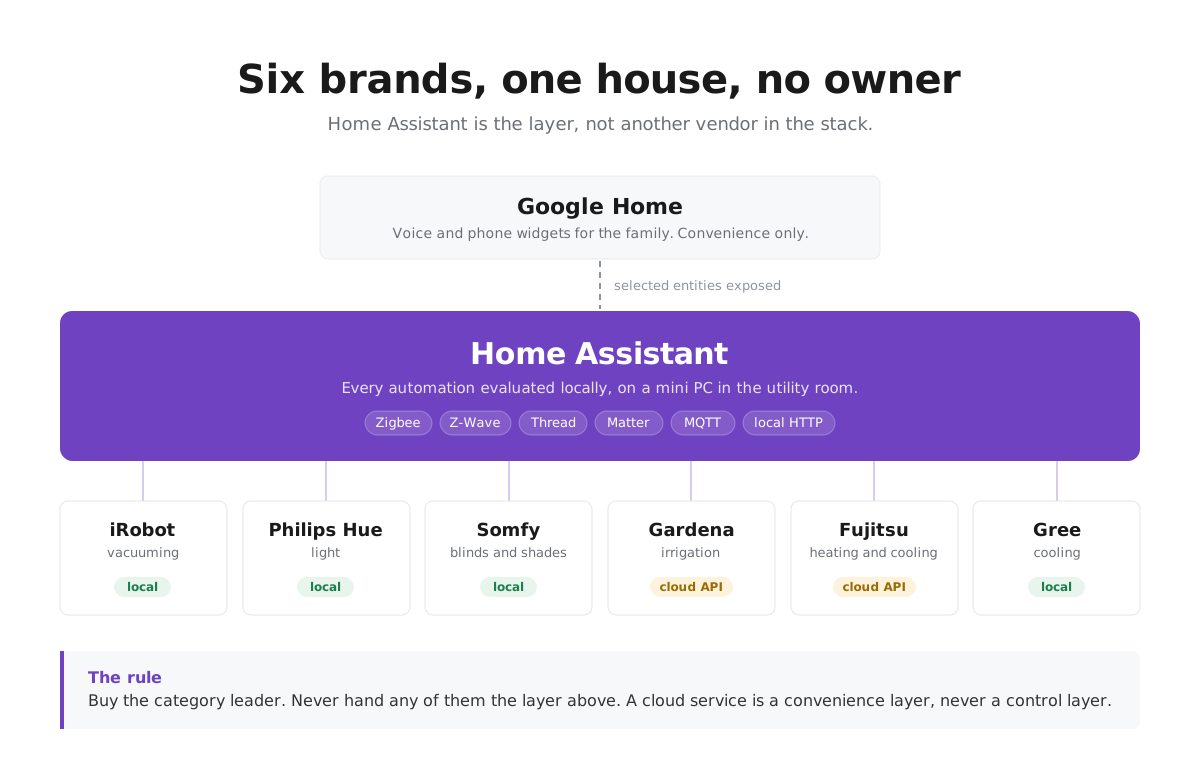
I buy the category leader in every room: iRobot, Somfy, Gardena, Fujitsu, Gree, Satel. Six brands means six apps and six islands. Home Assistant is the layer above them, running locally on hardware I own, so the house keeps working when the internet doesn't and the systems can read each other's data.
The pitch for a new build usually arrives as a catalog and a plan for everything in it. One brand for the lights, the same brand for the blinds, the same app, the same account, one number to call. It sounds restful. The question that decides it is what happens if that company gets bought, or decides the hub you paid for is now end of life.
So the house is being built the other way round. Home Assistant is meant to run the logic on a small machine in the technical room, Google Home handles voice for the family, Somfy drives the shades, and four more commercial brands sit underneath doing whatever each of them does best. This is why I chose that structure, and what it costs.
Why is every box in this house from a different company?
Because nobody makes the best product in all six categories, and pretending otherwise is how you end up with fourth-best lighting because you liked somebody's door lock. So let's clear up what this article is not. It isn't a purity test about proprietary systems, because almost everything I own is one.
I buy the leader in each category, and no two of them are the same company:
- iRobot for vacuuming, because a vacuum isn't a lock: when the cloud fails, the floor stays dirty for a day and nobody is hurt. I've lived with a Roomba j7+ for two years on that deal.
- Satel for the alarm, a wired panel an installer programs, which works with the internet unplugged and reaches Home Assistant over local TCP.
- Reolink for cameras, chosen for handing me an RTSP stream and a local integration rather than for the sharpest sensor.
- Somfy for the twelve external shutters and the garage door, specified before the windows were ordered. Picking a closed radio protocol for those is the one decision here that cuts against everything else on this page, and it gets its own argument.
- Gardena for irrigation, a company that built garden hardware long before it built apps, so the valves can be judged in their fifth year rather than their first week.
- Fujitsu for air conditioning and Gree for the heat pump behind the underfloor heating, two separate systems with two separate apps.
Lighting is the exception that proves the rule, and I'll say it plainly because it cuts against the paragraph above. The house is wired for unbranded Zigbee controllers paired straight to a USB dongle on the Home Assistant machine, and that hardware is the next thing I buy rather than something I can already show you. No bridge, no app, no account. There is no category leader in ceiling light worth its own bridge, so I took the trade the other way: no firmware guarantees and colour consistency that varies between batches, in exchange for a bulb with no opinion about who controls it and a replacement I can buy from anyone. I've spent about ten years in a flat collecting one bridge per brand, and I'm still doing it. That is the mistake I most wanted the house not to repeat.
Every one of those is proprietary. Every one arrives with its own app, its own account, and its own opinion about how a house works.
The decision that couldn't be taken back
It wasn't a philosophical choice. It was a wiring choice, and wiring choices are the ones you can't undo. Cable in a wall, a motor in a blind box, a valve under a screed: those are supposed to last twenty years, and none of them care about software. The software dies first.
So the question I had to answer before the plasterboard went up wasn't "which app do I like" but "what still works when the company behind it stops caring". Would you bet a buried motor on a startup's roadmap? The build forced this order on me, roughly the reverse of how most people shop:
- Decide where the logic runs, local or cloud. Every choice below inherits this one.
- Pick the radios the house will speak: Zigbee, Z-Wave, Thread, Matter, or wired.
- Pull cable and conduit for anything mains-powered, motorized, or behind plaster.
- Choose the category leaders that fit steps one and two.
- Add the household layer, voice and phone widgets, last of all.
Most people start at step five with a speaker that was on sale. Starting at step one kills the single-vendor plan quickly.
Six leaders means six apps
I know how that ends, because I did it by accident for about ten years. The flat I live in while the house is being built collected its smart home the way most people do: a SmartThings hub first, Philips Hue when I wanted light worth having, an eQ-3 MAX! Cube running the heating on 868 MHz, then Tuya and Xiaomi devices bought one annoyance at a time. Four ecosystems, none of them chosen against the others, every one of them a reasonable purchase on the day. What I actually ended up with was four apps and a flat where most devices couldn't react to the rest.
The moment you buy six category leaders, you own six apps, and that is the real, daily, unglamorous problem. It is much bigger than the philosophical one. Six icons on a phone, six notification styles, six logins my family would have to keep straight, and not one of those apps can see a single device belonging to any of the others.
Which of them is supposed to decide that the shades go down because the air conditioning is about to lose the argument with the afternoon sun? None of them can. Hue has no idea the Gree unit exists. Gardena can't read a forecast. iRobot can't tell whether the house is empty. That gap is the job I needed filled, and it is why the layer above matters more than any box below it.
Do the aggregators already solve this?
Partly, and I run one of them myself. Google Home and Samsung SmartThings both aggregate brands, and both do it well enough that the objection is fair. Neither could be the brain of this house, though, for two reasons: where the cross-brand logic is evaluated, and how far you can push the platform when the vendor never imagined your case.
| Capability | Home Assistant | Google Home | Samsung SmartThings |
|---|---|---|---|
| Where cross-brand logic runs | Local machine you own | Google's cloud | Cloud, some rules on the hub |
| House works with internet down | Yes, every automation | Voice and routines stop | Hub-local rules only |
| Extending the platform | Open source, your own Python and YAML | Home APIs, reviewed by Google | Edge drivers in Samsung's SDK |
| Custom dashboards | Hand-written cards, any layout | Vendor layout | Vendor layout |
| Long tail: vacuums, ovens, AV | First-class device types | Thin | Partial |
| Configuration you can back up | Plain YAML on your drive | Not exportable | Not exportable |
Where the logic runs
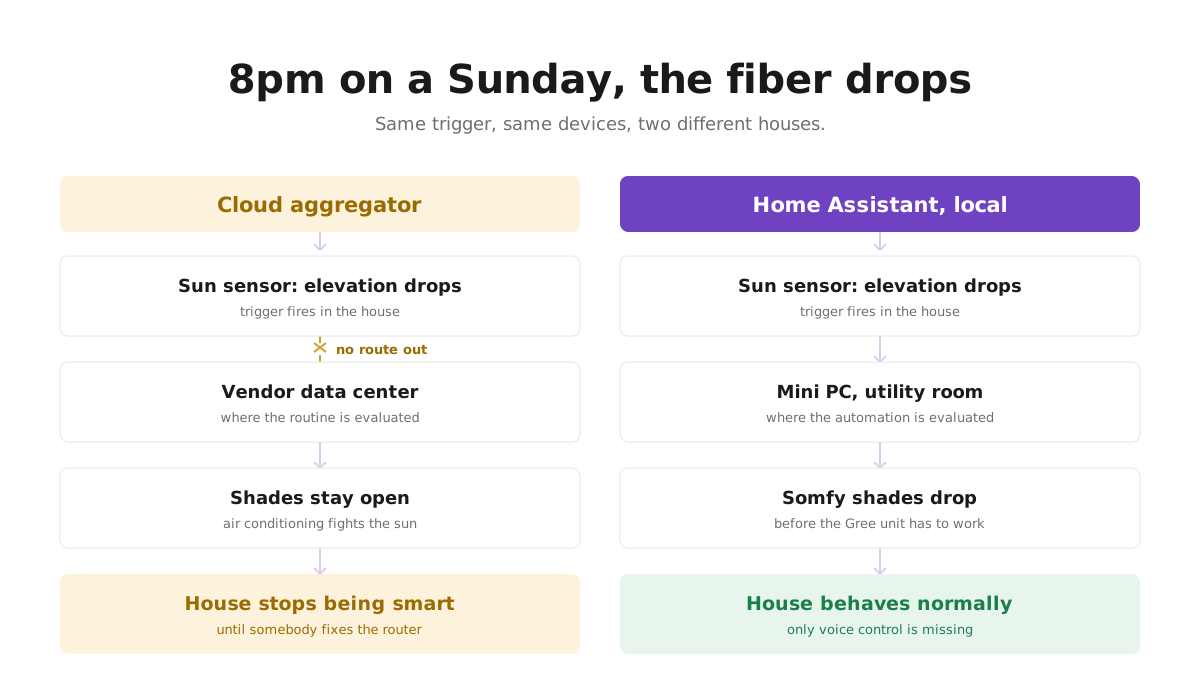
Home Assistant evaluates every automation on the machine in my technical room, which is the one property none of the commercial aggregators can offer. Both platforms think in a data center. SmartThings pushed a lot of work down onto the hub with Edge drivers, so more survives an outage than people expect, and a Nest hub keeps some Matter and Thread devices reachable locally. The routines you actually built, though, the ones spanning several brands, are evaluated on somebody else's servers.
So the fiber drops at 8pm on a Sunday, and the house stops being smart. Lights, heating, and shading are not features. They're the building working. Nothing that fails when a router reboots belongs in that layer, and that single sentence decided more of this build than any product review did.
What you're allowed to build on top
The second reason is the one that settled it, and it gets far less attention. On a closed platform you get what the vendor built: their trigger list, their conditions, their dashboard, their idea of what a good interface looks like. The moment your case isn't on the list, the conversation ends.
Both have a developer surface, Edge drivers on SmartThings and the Home APIs on Google's side, so this isn't a wall exactly. You're building inside somebody's sandbox with their review process and their deprecation schedule. You can decorate the platform. You can't fix it. The SmartThings comparison walks through where that boundary sits in practice. Ask what happens the day you want something nobody planned for: on one platform that's a feature request nobody reads, on the other it's an afternoon.
What does vendor lock-in actually cost?
Real money and real hardware, on a schedule that repeats every couple of years. Three shutdowns in the last six years make the pattern hard to miss: Insteon in April 2022, Wink's forced subscription in May 2020, and Belkin ending Wemo support with most of that hardware losing app control in January 2026. I own the survivor's version of this story. The heating in my flat runs on eQ-3 MAX!: radiator valves, window contacts, and wall controllers on 868 MHz, all reporting to a MAX! Cube LAN gateway. eQ-3 has retired the line. The valves still work. They still work because the Cube is a box on my own network that speaks to Home Assistant's maxcube integration over LAN, and no part of that chain needs a company to still exist. Compare that to the Wemo owners below, who did nothing wrong and lost app control anyway. Same age of hardware, opposite outcome, and the only difference is where the logic lived.
Then a window contact died, and I found the other half of the lesson. There was nowhere to buy another one. Not out of stock, not expensive, just gone: a discontinued 868 MHz sensor from a line the manufacturer had walked away from years earlier. Local control saved my automations. It did nothing whatsoever about the supply chain. The system still runs and it will keep running until the next piece of plastic gives up, and every failure from here is permanent.
So the rule I'd add to every lock-in argument, including my own: ask where the spare comes from. Local control protects the logic you built. Only a protocol somebody else still manufactures for protects the hardware. That is the actual reason the house went Zigbee, Z-Wave, and Matter instead of any vendor's clever radio, and it's why a dead window contact changed my buying rules more than any company's shutdown announcement did. None of what follows is an argument against buying commercial systems. It's an argument about which layer you let one company own. Buy the best camera on the market, by all means. Just don't let the company that made it decide whether your lights come on. The cost of getting that wrong is measured in hardware that still powers up and no longer does anything, sitting in a wall box you'd have to open to replace it.
The cloud gets switched off. Insteon went dark in April 2022. Not a slow wind-down with a migration path: the servers went offline, the app stopped working, and remote control went with it. The company only explained itself days later, blaming a failed sale and supply chain trouble, after customers had worked out for themselves that something was badly wrong. Google retired Works with Nest in 2019 and broke a huge number of third-party integrations people had built their routines around. Belkin announced the end of Wemo support with a firm date of January 31, 2026, after which the app and every cloud feature stop, and devices not already paired to HomeKit can't be set up at all. Every one of those users bought a working product, installed it correctly, and lost function anyway. None of them did anything wrong, and none of them had a lever to pull. What is the warranty on a product whose value lives on somebody else's server?
The subscription arrives, or the rules change quietly. Wink shipped hubs for years as a one-time purchase, then in May 2020 gave existing owners a week's notice to start paying $4.99 a month or lose access to gear already screwed to their walls. The deadline slipped by another week after the backlash, which changed the date and nothing else. That's the part that bothers me most. The lock-in is what makes the pricing change possible, because a customer who can't leave isn't really a customer. I went through the arithmetic across platforms in smart home subscription costs, and the totals over five years aren't small.
The uglier version is when nothing breaks and the terms just shift underneath you. A camera company gets acquired and the new owner rewrites the privacy policy. A vacuum maker starts monetizing floor plans. I dug into that specific pattern in what happens to your data when a robot vacuum brand changes hands, and the answer is rarely "nothing".
Why Home Assistant, specifically?
Because it is the only option that satisfies all three things this house needs: local evaluation of every automation, integrations deep enough to cover the awkward device categories, and source code I'm allowed to change. Automations run on the local machine without touching the internet, and the few integrations that do need it are the ones I refuse to hang anything important on. Plenty of platforms claim openness, and a few even deliver parts of it, usually the part that costs them least. Here's what convinced me, in the order I'd check them if I were starting a second house tomorrow. Nothing here is about ideology. Every item is about money or about a room going dark.
It runs on hardware I own
Home Assistant lives on a Raspberry Pi 5 mounted on a DIN rail in the electrical panel, powered from an industrial 5 V supply and backed by a UPS. Every automation evaluates there. When the fiber goes down, local automations carry on exactly as before, and only remote access disappears. Nothing in that chain phones a data center to decide whether a hallway light should come on at dusk.
That single property changes what you are willing to wire in. A device that needs a working internet connection to toggle a relay is not something I want behind a wall plate, and it certainly isn't something I want driving a motor I'd have to open a ceiling to replace. That rule is why cloud-only relays never made the shortlist, however good the app looked.
It speaks the protocols instead of a brand
The integrations directory runs to more than a thousand entries, but the number isn't the point. What matters is that Home Assistant talks Zigbee, Z-Wave, Thread, Matter, MQTT, and plain local HTTP, so my choice of light switch is not constrained by my choice of lock, and neither is constrained by whoever made my blinds. If you're still deciding which radios to standardize on, the protocol comparison is the piece I wish I had read before ordering anything.
Matter helps here, genuinely. The Connectivity Standards Alliance built it precisely so a device can join more than one ecosystem, which is real progress. It's also not the escape hatch people expect, because a Matter device still needs a controller and the vendor still controls the firmware. I went through that gap in what Matter actually is.
The integrations reach the awkward categories
Protocols are only half of it. The other half is brand-level integrations, and this is where Home Assistant stops having competition. Somfy comes in through the official Overkiz integration, so a TaHoma box and every io-homecontrol motor behind it show up as normal cover entities. That is the plan for the twelve shutters here; the link isn't made yet. Philips Hue talks to the bridge locally.
Beyond the usual lighting and sensors, there are whole device domains for the categories that break other platforms: robot vacuums from Roborock, Ecovacs, and Dreame with maps and per-room cleaning, ovens and washing machines through Home Connect, LG ThinQ, or SmartThings, and televisions and AV receivers from LG, Samsung, Sony, Denon, and Yamaha sitting in the same dashboard as the door sensors. That breadth is the practical difference. One script can dim a Hue group, drop the shades, pause the vacuum, and mute a receiver in four lines, because all four are entities in one system rather than four apps on a phone.
The systems talk to each other, not just to me
Here's the part that sold me, and it took a while to realize it was the main event rather than a bonus. Once six brands are entities in one system, they can act on each other's data. Four examples of what that allows:
- Sun elevation and outdoor temperature drop the external shades before the air conditioner in that room has to fight the afternoon. Shading beats cooling, every time, and a shade that closes at the right hour is worth more than a degree on the thermostat.
- Rain in the forecast tells Gardena to skip the cycle. The controller has no idea what tomorrow looks like. Home Assistant does.
- The vacuum runs when the house is empty and nobody is on a call, not on a fixed 10am schedule that ambushes whoever works from home that day.
- A window sensor opening kills the Fujitsu unit in that room, because cooling the garden is an expensive habit.
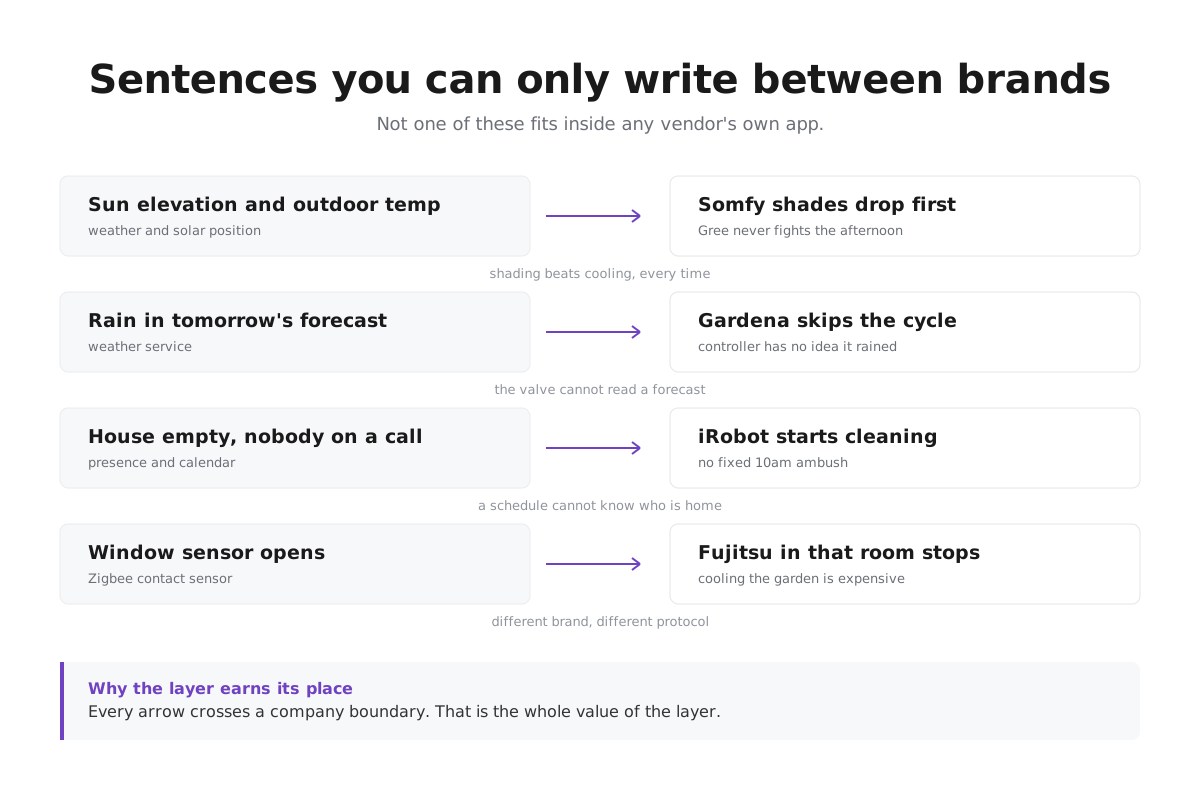
Not one of those can exist inside a vendor's own app, because each app only sees its own hardware. The value isn't in the boxes. It's in the sentences you can write between them.
Which integrations are local, and which are borrowed
Worth being honest about how each one arrives, because it isn't equal. Home Assistant's documentation classes the Hue, Gree, and iRobot integrations as local, so a dead router changes little about how they behave. Fujitsu's FGLair integration is classed as cloud polling, and the Gardena Smart System runs through the cloud via a community-maintained custom integration. That can work well, but it is still somebody else's server plus a volunteer's spare time, so nothing safety-critical should hang off either of them. Knowing which of your integrations is local and which is borrowed is worth more than any feature list. My rule of thumb: if losing an integration would leave a room cold, dark, or unlocked, it has to be local. Everything else can borrow somebody's API and I'll live with the outage.
Where a single-box hub runs out of road
The commercial hubs deserve a fair look, Homey Pro most of all. They are genuinely nicer to set up, the apps are polished, and for lights, plugs, sensors, and switches they cover the mainstream brands well. If that is your whole house, buy one and enjoy your weekend.
The problem is the long tail. Support on those platforms works per app, and an app only exists if the vendor or a volunteer wrote one for your exact model and still maintains it. The mainstream lighting is fine, and then you go looking for the vacuum's room-by-room cleaning, the washing machine's cycle-finished notification, or input switching on the AV receiver, and it is either missing, half-implemented, or a community app that stopped being updated two firmware versions ago. Ask yourself which devices you'd end up controlling from their own apps anyway, because that is the real measure of a hub. The Homey Pro versus Home Assistant comparison goes through the trade-off in detail, and the effort difference is real. I still went the other way, because a house that automates the lights but leaves the vacuum, the oven, and the TV outside the system is only partly automated.
When it doesn't exist, I write it
I've been writing software for roughly thirty years, so this weighs more for me than it will for most people. Home Assistant is Python and YAML, all of it open, all of it on a machine I own. That turns dead ends into afternoons. A device with no integration gets a custom component, and the API is usually two HTTP calls once you sniff the app's traffic. A dashboard nobody sells gets a Lovelace card in plain JavaScript. A number that exists nowhere gets a template sensor built from three others. Logic too tangled for YAML moves into AppDaemon or Node-RED, still my code on my hardware.
Shading logic is the example I'd point at. A rule that reads sun azimuth and elevation, which facade a room sits on, indoor temperature, and tomorrow's forecast, then decides how far each shade drops and when, is the kind of thing no product ships, because it's specific to one building. That's what I plan to write for the twelve external shutters. On a closed aggregator it would be a feature request nobody answers. That's the ceiling difference: on a vendor platform a wall ends the conversation, and here the wall is a file I can open.
The files are mine, and nobody can sell the project
My automations are YAML on a drive I can hold. Backups are files. If I move the whole system to different hardware next year, that's a restore, not a migration project with an exporter and a support ticket. Try getting your automations out of a closed platform in a format anything else can read, and you'll find there usually isn't one. If you can't take your automations with you, did you ever really write them?
The project itself sits under the Open Home Foundation, a non-profit set up in 2024 specifically so Home Assistant cannot be acquired and monetized the way its commercial rivals have been. That's not a marketing line; it's a governance structure, and it's the closest thing to a guarantee this industry offers.
Where Google Home fits, and why that isn't a contradiction
I get asked about this a lot, usually with a raised eyebrow. If I care so much about independence, why is Google Home still in the picture?
Because independence is about where the logic lives. Home Assistant runs everything and exposes a curated set of entities to Google Home, which handles voice and the phone widgets my family actually uses. Nobody in this house is going to open a YAML file to turn off a lamp, and expecting them to would be a design failure on my part, not a virtue. If Google changed the terms tomorrow, I would lose voice control and keep every automation. That asymmetry is the whole point, and it's roughly the trade-off I described in the platform comparison.
The rule I apply: a cloud service can be a convenience layer, never a control layer.
A cloud service can be a convenience layer in your house, never a control layer.
Is Home Assistant just a nicer prison?
It's a dependency, yes, but a different sort, and I'd rather answer the challenge than pretend it doesn't exist. If the project imploded I'd have work to do. The difference is what survives the collapse.
My devices speak standard radio protocols to a coordinator I own, so they'd pair with openHAB, Hubitat, or whatever came next. My configuration is readable text. My history sits in a local database. Compare that with a platform where the devices only ever spoke to one company's servers, and the distinction stops being academic. There is a real cost, though, and it isn't money. It's that I'm the support desk. When something breaks at 11pm, no one is coming. That trade-off is examined honestly in is Home Assistant worth it, and it genuinely isn't the right answer for everyone.
The rules I buy hardware by now
Picking the category leader comes first. Then the shortlist, before anything gets ordered:
- Local control exists. The device can be operated with the internet unplugged, through Zigbee, Z-Wave, Thread, Matter, or a documented local API.
- It survives a router reboot without needing to be re-paired or re-authorized.
- The radio is standard, not a proprietary variant that only that vendor's hub understands.
- Firmware updates are optional, or at least do not brick features I already rely on.
- No mandatory account for basic operation. An account for extras is fine.
- Nothing critical is cloud-only. Locks, heating, and anything wired into the fabric of the building must work without a service.
- It shows up cleanly in both Home Assistant and Google Home, because a device my family cannot control by voice may as well not be smart.
- I can still buy the ninth one. More than one manufacturer makes something compatible, so a failed sensor is an order rather than the end of the system. This is the rule I learned the hard way, and it's the one most reviews never mention.
Anything that fails two of these doesn't get bought. Anything that fails the first one doesn't get wired in, no matter how good the app looks in the review videos.
What this actually cost me
Honesty demands the other column. Going this route costs setup time, a Raspberry Pi 5 with a power supply, a Zigbee coordinator, and a standing habit of keeping the configuration tidy. It costs the ability to phone one number when something misbehaves. It means passing on devices that look great but are cloud-only. Is that a fair price for a house that ignores outages? For me it isn't close.
What it bought is a house that behaves like one machine instead of six. One dashboard, one place where the automations live, one app the family opens, and six commercial systems underneath doing what each of them does best. The automation logic belongs to the house: no manufacturer owns it, and none can revoke it. No renewal date, no acquisition, and no policy update can reach in and rewrite the logic. Twelve blinds are on Somfy motors and TaHoma today, and bringing that into Home Assistant through the Overkiz integration is the next job rather than a finished one, which is exactly why I care that the integration is official and local rather than a favour somebody might withdraw. For a system that is literally built into the walls, that felt like the only sane way to spend the money.
If you are at the same fork, start with hardening the setup properly before you connect anything to the outside world. Local control only counts as an advantage if you don't undo it the first time you want remote access.
Frequently Asked Questions
Does avoiding vendor lock-in mean avoiding cloud devices entirely?
No, and I didn't manage that anyway. It means the cloud is never allowed to be the only path to a device. A camera that uploads clips to a vendor account is fine if it also exposes a local stream. A lock that only opens through one company's servers isn't, because the day that company changes its business model, my front door changes with it.
Why not use Google Home or SmartThings as the hub?
Both aggregate brands, and both evaluate the important logic in the cloud. SmartThings runs more on the hub than it used to, and a Nest hub keeps some Matter devices local, but cross-brand routines still depend on the internet, and a house shouldn't stop working when the fiber does. The second limit matters just as much: you get the triggers, conditions, and dashboards the vendor built. Home Assistant is open source, so when something is missing I can write it myself.
Why not just use each brand's own app?
Because six category leaders means six apps, and none of them can see a device belonging to any of the others. Hue can't know the Gree unit is about to run, Gardena can't read tomorrow's forecast, iRobot can't tell whether the house is empty. Home Assistant puts all of it in one app and, more usefully, lets those systems act on each other's data.
Is Home Assistant not just a different kind of lock-in?
It's a dependency, but a different sort. The software is open source under the Open Home Foundation, the configuration sits in plain YAML files on my own drive, and the devices underneath speak standard protocols like Zigbee, Z-Wave, and Matter. If I walked away from Home Assistant tomorrow, every one of those devices would pair with something else.
Why keep Google Home if the goal is independence?
Because independence is about where the logic lives, not about who answers when someone says "turn off the kitchen lights". Home Assistant runs every automation locally and exposes selected entities to Google Home. Unplug the internet and the house still works; you just lose voice until it comes back.
Does Home Assistant integrate with Somfy, Philips Hue, and appliances?
Yes, and that breadth is a large part of why I picked it. Somfy TaHoma arrives through the official Overkiz integration, Philips Hue talks to the bridge locally, and there are dedicated device types for robot vacuums (Roborock, Ecovacs, Dreame), kitchen and laundry appliances (Home Connect, LG ThinQ, SmartThings), and televisions and AV receivers (LG, Samsung, Sony, Denon, Yamaha). Single-box hubs like Homey Pro cover mainstream lights, plugs, and sensors well, but that long tail is where they thin out.
What happens to my automations if a manufacturer shuts down its cloud?
With a local platform, a shutdown costs you the vendor app and any cloud-only features, not the device. Zigbee and Z-Wave hardware keeps talking to your own coordinator because the radio protocol never involved the manufacturer's servers in the first place. That's the whole argument for local control in one sentence.
Sources & References
- Home Assistant integrations directory (official documentation) home-assistant.io Documentation
- Open Home Foundation openhomefoundation.org Organization
- Matter standard (Connectivity Standards Alliance) csa-iot.org Standards
- Belkin support notice on the end of Wemo cloud services belkin.com Manufacturer notice
- The Register on the Insteon cloud shutdown theregister.com News
- 9to5Mac on Wink's mandatory hub subscription 9to5mac.com News