Tracking room temperature and humidity with IKEA TIMMERFLOTTE
Product Details
🏭 Manufacturer: IKEA
🔌 Plug Format: Battery (2x AAA, sold separately)
📄 Specification Met: CE, Matter 1.3
🔖 Part Number: 606.189.52
🏋️♂️ Weight: 28 g (1 oz)
📏 Dimensions: 65 mm x 18 mm
🆔 Model Number: E2314
📐 Size: 65 mm diameter disc, 18 mm deep
🎨 Style: Battery-powered round sensor
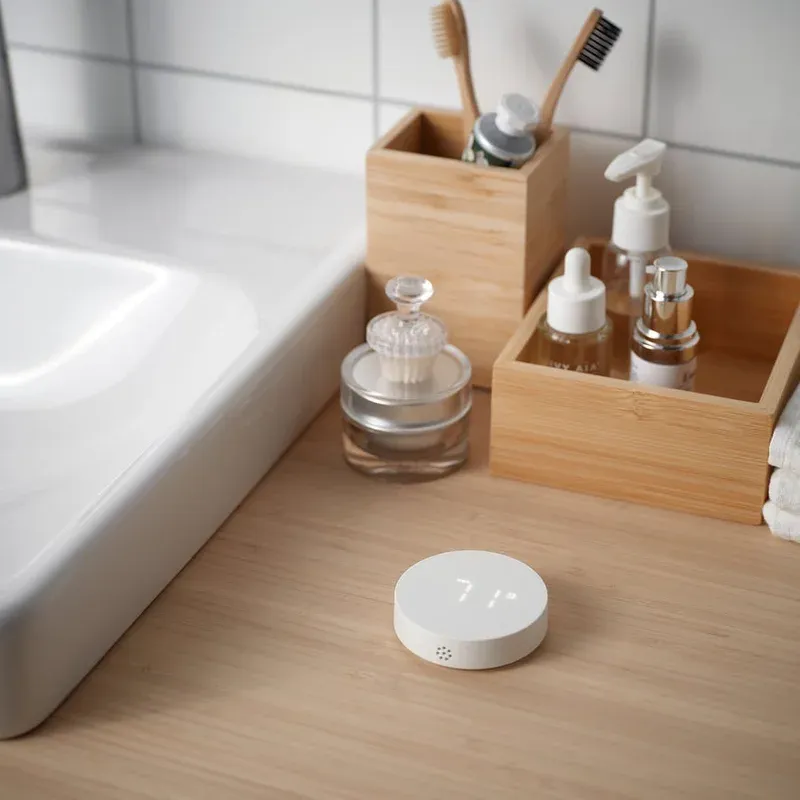
🧲 Mounting Type: Desktop, Wall Mount
🔧 Usage: Indoor Use
🧩 Included Components: TIMMERFLOTTE sensor (batteries sold separately)
🔋 Batteries Required: Yes
The Rundown
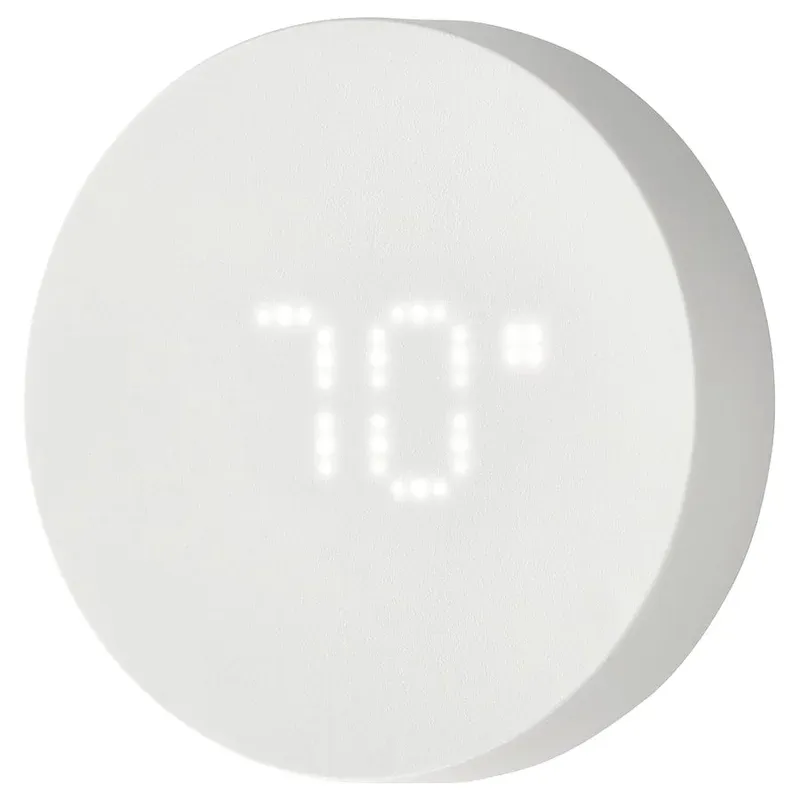
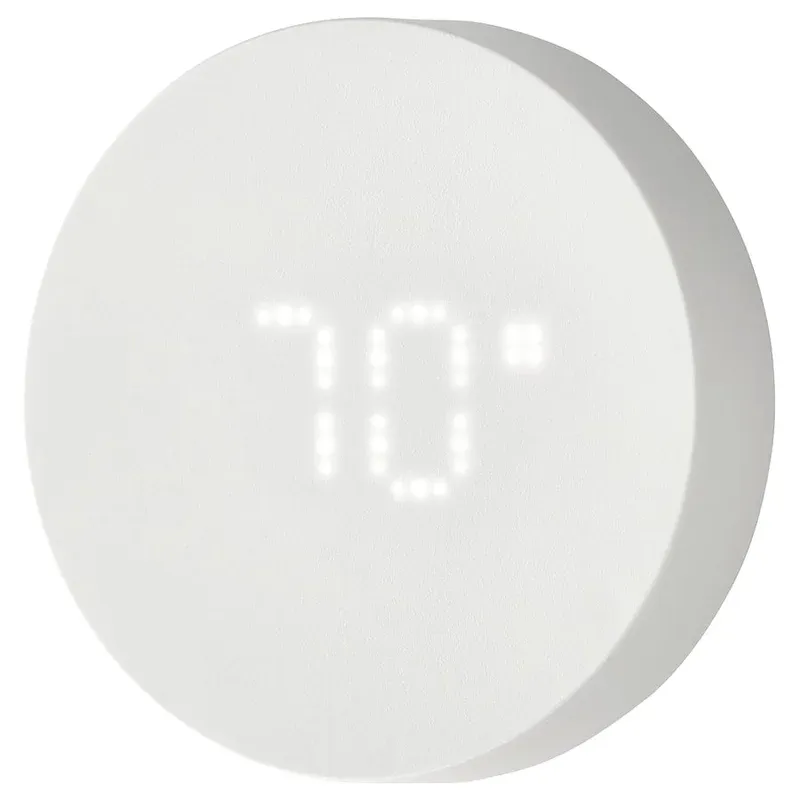
The IKEA TIMMERFLOTTE is a white 65 mm puck that measures room temperature and relative humidity, shows both on a hidden LED dot display when you press it, and reports them to your smart home over Matter over Thread. IKEA lists it at 11.99 USD in the US and 5 GBP in the UK, with eurozone stores around 10 EUR. That's it. No screen glass, no app account, no subscription hiding behind a QR code.
Why does a cheap thermometer deserve a full page? Because of what it represents. TIMMERFLOTTE was IKEA's first Thread radio ever shipped, the opening move in the company's switch from its old Zigbee accessory line to native Matter devices, and it set the pattern the rest of the lineup now follows: open standard, any major ecosystem, pocket-money pricing.
The display is the part guests actually understand. One press shows temperature, another shows humidity, and the dots fade out afterwards to save power. Everything else, the Thread radio, the Matter fabric, the automations, stays invisible.
Under the Hood
The disc measures 65 mm across and 18 mm deep, weighs about 28 g (1 oz on IKEA's US spec sheet), and is molded from ABS plastic. W Braasch and M Arvonen are credited as designers, which is a very IKEA touch for a device this small. It sits on a shelf, or goes on a wall; IKEA says no mounting screws are needed.
Power comes from 2x AAA batteries, and they're not in the box. IKEA points you at its LADDA HR03 1.2 V rechargeables, though ordinary 1.5 V disposables work too. I'd have preferred a pair of cells included at this price, but batteries-excluded is how IKEA keeps the sticker low, and rechargeables are the better habit anyway.
The interesting part is the certification record. The device carries model number E2314, hardware version P2.1, and is Matter 1.3 certified under ID CSA25671MAT46531-24. You can verify all of it against the Connectivity Standards Alliance certification database rather than taking a marketing page's word.
One spec IKEA doesn't publish anywhere: accuracy. There's no stated tolerance for temperature or humidity, no sensing element named, nothing like the plus or minus figures Aqara or SONOFF print for their Zigbee sensors. For trend tracking and automation triggers that's fine. For calibrating a humidor, look elsewhere.
TIMMERFLOTTE is certified as a Thread Sleepy End Device. It wakes, reports, and goes back to sleep, which is what stretches a pair of AAAs across months. The flip side matters when you plan a network: it never routes traffic for other Thread devices, so ten of these strengthen your mesh by exactly nothing. Mains-powered devices do that job.
Works With
Commissioning follows the standard Matter route: scan the QR code from a hub app over Bluetooth, and the sensor joins your Thread network. You need a Thread Border Router first. The IKEA DIRIGERA hub is the obvious pick inside IKEA's world, and Apple HomePod mini, Apple TV 4K, Google Nest Hub 2nd gen, and Amazon Echo 4th gen all work the same way. IKEA names Amazon, Apple, Google, Homey, and Samsung as compatible ecosystems.
For this house the question is always the same: does it slot cleanly into Home Assistant plus Google Home? On paper, yes, twice over. Home Assistant's Matter integration picks the sensor up once any border router carries it, exposing temperature and humidity entities that update locally. Google Home shows the same readings to the rest of the household without anyone learning what a fabric is. One device, both layers, no vendor cloud in the loop.
Inside Home Assistant the practical move is to rename the two entities the moment they appear, sensor.bathroom_humidity beats sensor.timmerflotte_2 forever, and to add them to a history graph card right away. Matter also reports the battery level as its own entity, so a low-battery notification automation costs you two minutes now and saves a dead sensor discovered three weeks late. On the Google Home side the readings just show up on the room card, and "what's the humidity in the bathroom" works as a voice query without any setup at all.
Now the honest caveat. My own sensor fleet is Zigbee, several dozen devices hanging off a Home Assistant Connect ZBT-1 coordinator, and there's no Thread Border Router in the building yet. So treat the pairing walkthrough here as specification reading, not a first-hand log. What I can speak to is the battery-sensor pattern itself, because my Zigbee door, leak, and soil sensors live exactly the way this device does: sleep, wake, report, sleep.
Local control and what survives a router reboot
Matter runs on your LAN. Readings don't detour through IKEA's cloud, and an automation like "humidity over 65 percent, start the fan" executes locally in Home Assistant or DIRIGERA. Internet outage? Readings keep flowing. That's the property this blog filters every device through, and TIMMERFLOTTE passes it without an asterisk. Firmware arrives as OTA updates through your hub app; the certification trail shows IKEA has already shipped at least two builds, which suggests the update channel actually gets used.
When It Makes Sense
Where does a 10 EUR climate puck earn its shelf space?
- A bathroom, where a humidity spike after a shower can start the exhaust fan and dryness can stop it again, no timer guesswork
- A bedroom, because overnight temperature drift is the first thing to check when sleep quality dips, and the button gives a reading without waking a phone
- A basement or utility corner where slow damp does its damage silently and a logged humidity curve catches it weeks before your nose does
- Next to a thermostat you don't quite trust, as a second opinion feeding the actual heating logic in Home Assistant
Getting It Running
Setup is short. Pop in two AAAs, open your border router's app, scan the Matter QR code, assign a room. The Bluetooth handoff to Thread takes under a minute on most hubs, and readings appear once the sensor settles.
Placement decides whether the numbers mean anything. Keep it off exterior walls, out of direct sun, and away from vents and radiators; a sensor above a heat source reports a fiction. Chest height on an interior wall or an open shelf gives the most representative room reading.
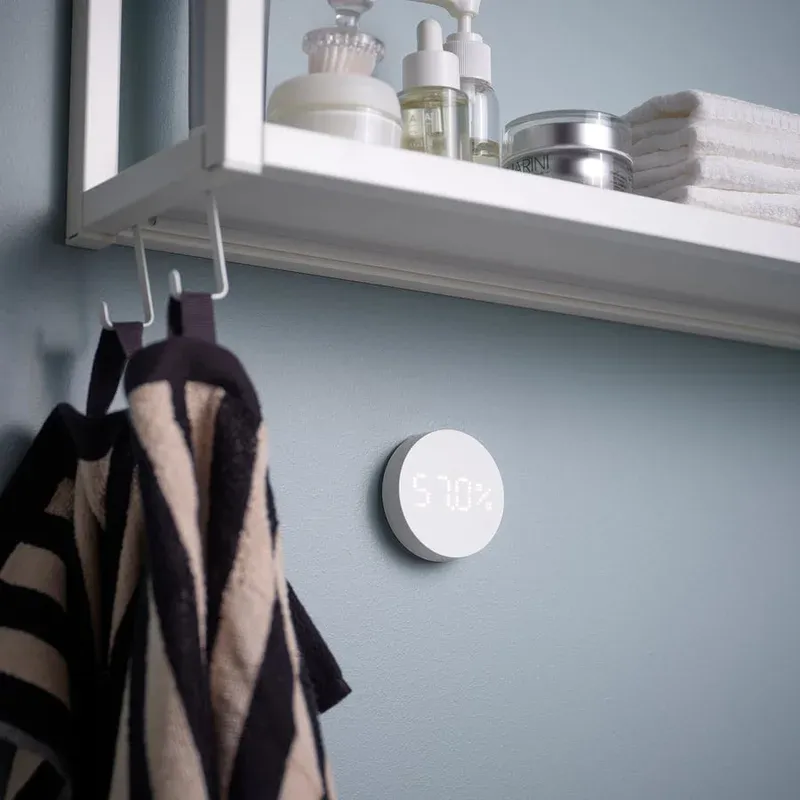
The screwless wall option matters more than it sounds. In a tiled bathroom, drilling for a 10 EUR gadget is a hard sell, and shelf space next to a sink tends to be contested territory. Stuck flat on a painted wall at eye level, the sensor doubles as the room's humidity readout, and the display answers before your phone has even unlocked. Is that a gimmick? A little. It's also the reason the rest of the household tolerates the device instead of asking what the white puck is for.
Pick thresholds from data, not folklore
Don't automate on day one. My soil-moisture probes taught me this the annoying way: the first threshold I set was wrong twice before a week of logged readings showed what normal actually looked like in that spot. Humidity behaves the same indoors. Log a full week of showers, cooking, and weather swings, then set the fan trigger where your rooms actually live, not where a forum post says they should.
TIMMERFLOTTE vs the Zigbee Route
This house runs unbranded Zigbee sensors paired straight to a USB dongle, so the fair comparison isn't SwitchBot's app-first meters, it's the cheap Zigbee pucks from SONOFF and Aqara. Those often cost about the same, publish accuracy specs, and some add a permanent e-ink display TIMMERFLOTTE lacks.
So which one? It hangs on a single question: what radio does your house already speak? Dropping one Thread device into a Zigbee home means buying and running a border router, which quietly turns a 10 EUR sensor into a much larger decision. That's my one real objection to this product, and it isn't the product's fault. If a HomePod, recent Nest Hub, or DIRIGERA already sits on the shelf, the border router is paid for and TIMMERFLOTTE becomes the cheapest native-Matter climate sensor you can grab with the groceries. Its mains-powered sibling, the IKEA ALPSTUGA, adds CO2 and PM2.5 sensing and strengthens the Thread mesh while it's at it; the two are designed to be bought in bulk and scattered.
Final Verdict
Full disclosure first: I don't own a TIMMERFLOTTE, and this page reads IKEA's published specification and the CSA certification record rather than a unit on my desk. The role it plays, though, is one I run daily on another radio, and the design decisions all check out from there.
What IKEA got right is restraint. A display for humans, Matter for machines, local operation, a price that makes per-room coverage reasonable instead of aspirational. What's missing is a published accuracy figure and a pair of batteries in the box. For a household with a Thread Border Router already running, it's an easy yes and you should buy several. For a Zigbee house like this one, it's the sensor that finally makes the border-router question worth answering.
Frequently Asked Questions
Does IKEA TIMMERFLOTTE need a hub to work?
Yes, for smart home use. TIMMERFLOTTE speaks Matter over Thread, so it needs a Thread Border Router such as the IKEA DIRIGERA hub, Apple HomePod mini, Apple TV 4K, Google Nest Hub 2nd gen, or Amazon Echo 4th gen. With no hub at all it still shows readings on its own display at a button press.
Does TIMMERFLOTTE work with Home Assistant?
Yes. Once the sensor is commissioned through any Thread Border Router, Home Assistant's Matter integration exposes temperature and humidity as two entities. Updates stay on the local network, so automations keep firing even when the internet connection is down.
Does TIMMERFLOTTE extend my Thread mesh network?
No. It is certified as a Thread Sleepy End Device, which means it sleeps between reports to save battery and never routes traffic for other devices. Only mains-powered Thread devices strengthen the mesh.
Are batteries included with TIMMERFLOTTE?
No. It takes two AAA batteries that are sold separately. IKEA recommends its LADDA HR03 1.2 V rechargeables, and standard 1.5 V disposable AAAs work as well.
How much does the IKEA TIMMERFLOTTE cost?
IKEA lists it at 11.99 USD in the US and 5 GBP in the UK, with eurozone stores around 10 EUR. That makes it one of the cheapest Matter-certified climate sensors sold in a physical store.