The Wife Acceptance Factor: Start With the Person Who Doesn't Care


This post may contain affiliate links. As an Amazon Associate we earn from qualifying purchases. Disclosure.
Every smart home guide says to start with a hub, a protocol or an ecosystem. In a house with other people in it, that's the wrong first step. Two small automations convinced a sceptic here, and neither was built for me.
Every guide I read before building this house told me where to start. Pick a hub. Pick a protocol. Pick an ecosystem you can't easily undo. Not one of them mentioned the person who has to live with whatever I picked, and that person has a veto.
TL;DR: In a house with other people in it, the first automation shouldn't be yours. Find the daily irritation of the person least interested in smart homes and remove it so completely they stop noticing. Here, two small things did it: a door contact that lights the wardrobe, and a robot vacuum that runs every one to two days.
Forums call this the wife acceptance factor, and it's the one factor no spec sheet scores. My wife wasn't indifferent to smart home gear. She was sceptical, and that's a different animal. An indifferent person ignores your hobby. A sceptic watches it for the first thing that breaks. I won't put words in her mouth, so I'll just say the starting position was "prove it", and neither of the things that did were on my list of impressive projects.
What Convinced a Sceptic in a Single Day?
The wardrobe. It's small and dark, and you don't walk into it so much as stand in the doorway and reach. Anyone who has fumbled for the right shirt at 6 AM knows how that goes.
The fix is almost embarrassingly plain: a contact sensor on the door and a Sonoff ZBMINI relay sitting behind the existing wall switch. The door opens, the bulb comes on. That's the entire rule. No scene, no schedule, no condition.
It worked the first time, and she noticed within a day, which in my experience beats a month of explaining. No energy dashboard did that. Neither did the shading logic I'm planning for the blinds, which I was a lot prouder of. A relay and a door.
 Photo by Chuck Pang on Unsplash
Why Did a Door Contact Beat a Motion Sensor?
Because of how the space is used. A passive infrared sensor needs to see a person, and a person standing in a doorway while barely moving is exactly what it handles worst. I'd have bought a motion sensor first, the same way most guides suggest, and it would have been the worse choice.
The door is the only signal that matters here. A contact sensor reads it instantly, with no warm-up and no dead zone, and it costs less. If your wardrobe is a cupboard rather than a room you walk around in, skip the motion sensor entirely. That's a conclusion from living with it, not from a spec sheet.
What Does the Wall Switch Still Do?
Exactly what it always did. The ZBMINI is an in-wall relay, so it sits behind the switch rather than replacing it, and the key on the wall carries on working like any other. This matters more than it sounds. An automation that takes a familiar control away has to earn its place twice. One that only adds a second way to get light asks for nothing from anybody.
One practical warning if you copy this. Sonoff sells relay versions that need a neutral wire in the switch box and versions that don't, and the difference decides whether it's a ten-minute job in an older flat. Check which you're buying before you open the wall. In the house I'm building, a neutral wire was settled at the cable stage, in every switch box, so the question never comes up. Retrofitters don't have that luxury.
Why Did the Robot Vacuum Win on Frequency, Not Suction?
Second conversion, same pattern. She was sceptical about the robot vacuum too. In the flat it's an iRobot Roomba Combo j7+, and it's now been running for over two years. Her verdict, in so many words, is that she can't imagine life without it.
Here's the part no roundup mentions. The robot doesn't clean better than a person with a good vacuum. It cleans dozens of times more often. It goes out every one to two days, and because of that you never feel sand under bare feet, something that was simply out of reach with manual vacuuming. Suction power, mapping and dock design are arguments about second-order details. Cadence is the first-order one.
I'd go further. If you're comparing robot vacuums by suction figures, you're choosing on the wrong axis. Pick the one you'll actually let run every other day, because the schedule is what changes the experience in a house.
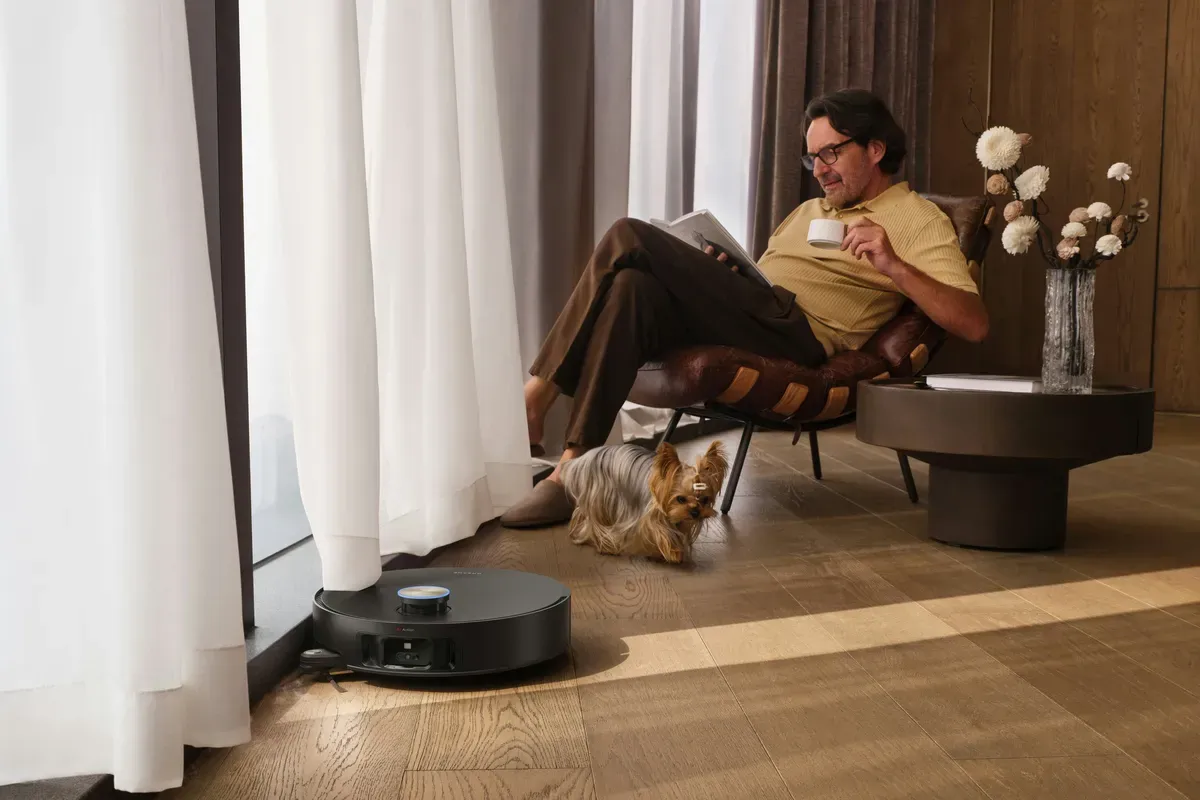 Photo by Dreame Vacuum Cleaner on Unsplash
What Is the One Thing Still Needing a Human?
The water and detergent tank. The dirt bin isn't the problem, because the dock empties it. But the tank has to be carried to the tap and refilled regularly, and in my words, if it weren't for that, the vacuum would be fully self-service.
That's a buying lesson in itself. The industry sold self-emptying docks as the feature that frees you, and solved the half of the chore nobody complained about. Emptying a bin once a fortnight was never the pain. Carrying a tank to the tap every few runs is. So when I buy the next one, the first question isn't how much dust the station swallows. It's whether the station refills water. Most spec comparisons put that row at the bottom, if they list it at all. For the full cadence argument, the cleaning routines guide in the related reading below goes through how to set it up.
A robot vacuum doesn't clean better than you do. It cleans dozens of times more often, and that's the whole product.
What Do the Two Conversions Have in Common?
Look at what actually changed her mind. It wasn't a feature. It was an irritation that disappeared: fumbling in a dark wardrobe, grit underfoot. And it wasn't my irritation either. I'd have lived happily with both problems forever.
That's the pattern, and I think it's the most useful thing I've learned from a decade of piling up smart home gear. A sceptic isn't persuaded by capability. A sceptic is persuaded by the absence of a nuisance they used to put up with, delivered without asking them to do anything new. The best automation here is the one nobody mentions.
Compare that with the usual advice, which starts from the hub. A hub is the thing you care about. It's a decision about your hobby. The first decision about a family house should be about their day.
Which Four Tests Should the First Automation Pass?
If you're choosing where to begin in a house with other people, run the candidates through these:
- It belongs to the least interested person. Not yours. If you'd build it anyway for fun, it fails.
- It fixes something daily. A weekly annoyance gives you seven chances to get it wrong before anyone notices it's gone.
- It needs nothing new from them. No app to open, no phrase to remember, no dashboard.
- It leaves the old way working. The wall switch still switches. Taking a control away costs trust you haven't yet earned.
A door contact on a wardrobe passes all four. So does a robot vacuum on a schedule. A fancy presence-detection scene with a custom dashboard passes none of them, however good it looks to the person who built it.
What Can Wreck the Goodwill?
Failure, quietly. I've learned this on the flat's cloud-based routines, which stopped firing during internet outages with no error and no alert. The only sign was a dark room. A sceptic collects exactly that kind of evidence, and one of those evenings can undo months of patience.
It's why the house leans the other way. The logic lives on a Raspberry Pi 5 inside the electrical cabinet, with a UPS under it, rather than anyone's cloud. I'll be straight about the cost, too: the key on the wall is an input to Home Assistant rather than a break in the circuit, so if the server is down, the light is down. I accepted that single point of failure on purpose, and the UPS is there to shrink it. But a spouse forgives a slightly wrong colour temperature. A dark hallway at night is another matter. The related piece on vendor lock-in explains the thinking behind keeping the logic local.
What Can't I Tell You Yet?
Quite a lot, and it's better said plainly. Two conversions in one household is a pattern, not a study. Your sceptic may care about different irritations entirely: a dishwasher that finishes at the wrong hour, a bathroom fan that's never on when it should be.
I also can't yet say how the rest of the family will treat the system once the house is lived in. Whether anyone other than me ever opens the Home Assistant dashboard is still an open question. The plan for the family-facing layer is Google Home: a Nest Mini and a Nest Hub Max that I'm happy with in the flat will move across, and each room should end up with a speaker or a screen. That's a plan, not a result, and I'd rather report the result after a winter of living there. And there's a longer list of things the family has switched off or refused that I haven't collected yet. That list will be more useful than this one.
Until then, the advice I'd stand behind is short. Start with the nuisance, not the network. If you'd like the radio side of the question afterwards, the Thread, Zigbee and Matter scenario guide is where to go next, and the sensor picks in the related list cover which contact sensors are worth buying.
Hero photo by Advaith Narayan on Unsplash
Frequently Asked Questions
What is the wife acceptance factor in a smart home?
It's the informal test of whether the other people in the house will put up with the system. A setup that delights the person who built it and annoys everyone else fails the test, however clever it is. The practical consequence is that the first automations should solve a daily problem for the household member who cares least about the hobby, not showcase what the hub can do.
What should the first smart home automation be in a family home?
Pick one daily irritation that belongs to the least interested person and remove it completely, with no app, no voice command and nothing new to learn. A light that comes on when a door opens is the classic example, because it works the first time and the old wall switch keeps working. Save dashboards, energy graphs and presence logic for later.
Is a door contact sensor better than a motion sensor for closet lighting?
For a small, dark wardrobe that you use from the doorway, yes. A motion sensor has to see a person, and someone standing still in the door barely registers. A contact sensor reads the one signal that matters, the door being open, instantly and with no dead zone. If the space is a walk-in room where people move around inside, adding motion to keep the light on is reasonable.
Sources & References
- Home Assistant - Automating Home Assistant home-assistant.io
- Home Assistant - Binary sensor home-assistant.io
- Home Assistant - iRobot Roomba and Braava home-assistant.io