Zemismart ZME2: One Inline Module, Two Circuits on Matter
Product Details
🏭 Manufacturer: Zemismart
🔌 Plug Format: AC Power (100-240V~)
📄 Specification Met: Matter certified (CSA certificate CSA23836MAT41349-24)
🔖 Part Number: ZME2
📏 Dimensions: 50.2 x 51.5 x 21.2 mm
🏳️ Country of Origin: China
🆔 Model Number: ZME2
📐 Size: 50.2 x 51.5 x 21.2 mm
🎨 Style: Dual relay inline module
🧲 Mounting Type: Wall Box
🔧 Usage: Indoor Use
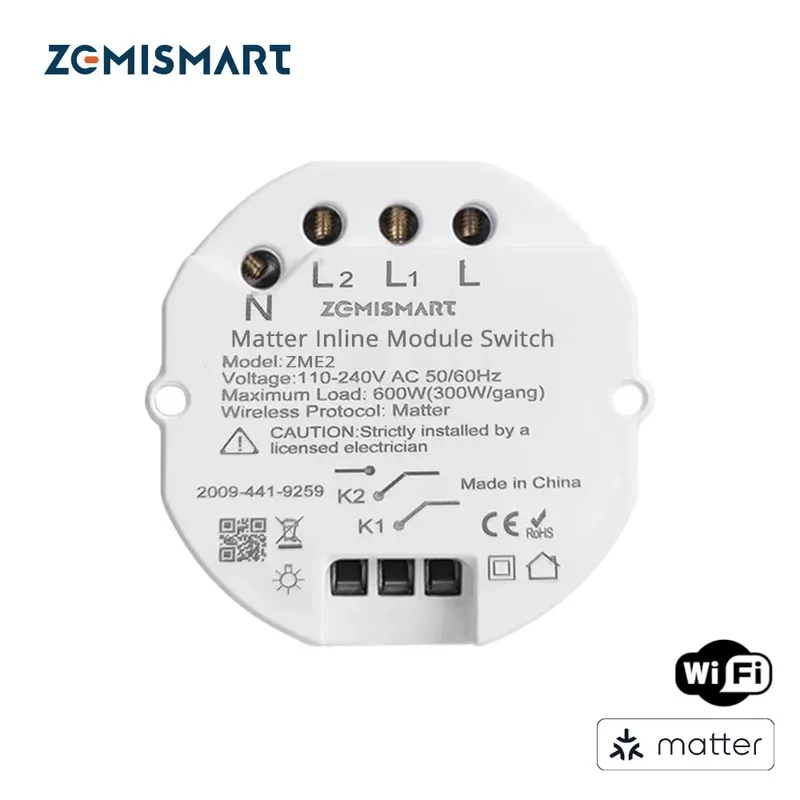
Zemismart sells the ZME2 for $14.90 on sale, down from a list price of $24.83, and for that money you get two independently switched circuits out of one module small enough to vanish into a wall box. The pitch is simple. Wire your existing switches through it, commission it over Matter, and both channels appear in your smart home app without changing any hardware a guest would ever see. This one hasn't been wired into our house, so what follows is a researched writeup: the manufacturer's listing, the Matter certification database, and an independent teardown review, cross-checked against each other. They don't all agree. The disagreements turned out to be the most useful part.
What the ZME2 Actually Is
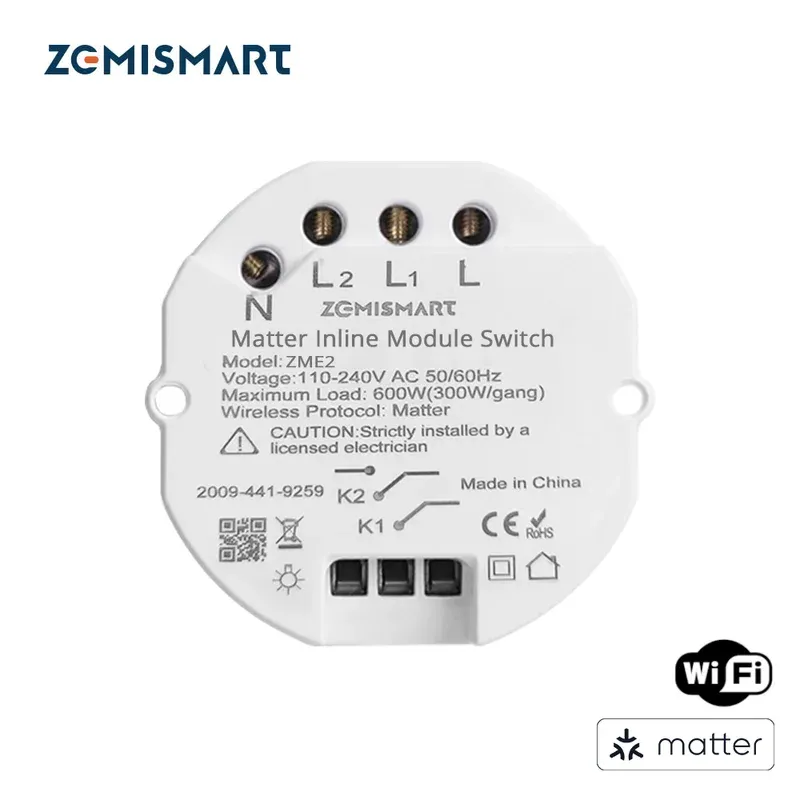
The ZME2 is a dual relay inline module measuring 50.2 x 51.5 x 21.2 mm, built to hide behind an existing wall switch or in a junction box. It accepts AC 100-240V at 50/60Hz and switches up to 600W in total, which Zemismart splits as 300W per gang. That's a lighting budget, not an appliance budget. Two ceiling fixtures, a light plus a fan, a pair of hallway circuits: that's the intended territory, and anything with a motor or a heating element should go elsewhere.
Here's a detail the spec sheet doesn't advertise. SmartHomeScene's teardown found two Fanhar W11 relays inside, each rated at 10A, so the hardware carries far more headroom than the printed 300W limit suggests. Treat the 300W figure as the number that counts anyway, since it's the one the manufacturer stands behind. The radio side is a UAM023 module from Shenzhen Uascent Technology with 2.4GHz WiFi (802.11 b/g/n) plus Bluetooth 5.1, the Bluetooth being there for commissioning rather than day-to-day control. The reviewer also called out the build quality, noting a thick layer of solder at the terminals, and wished out loud for 16A relays instead.
Matter Over WiFi, Checked Against the Certification Database
Matter over WiFi is the headline claim, and it checks out. The Connectivity Standards Alliance database lists the Zemismart Inline Module under certificate CSA23836MAT41349-24, certified on July 12, 2023, with firmware 1.6, hardware 1.0, and WiFi as the transport. The registered device type is a plain on/off switch. No dimming, no power metering, no scenes baked into the device itself.
What does Matter over WiFi buy you in practice? Control traffic stays on your LAN, so a dead internet connection doesn't take your lights with it, and there's no vendor cloud account standing between your switch and your hub. The dependency it does keep is your 2.4GHz WiFi network itself. Every module like this is one more client on the band, and after a power cut it has to rejoin before it responds, which a Zigbee mesh handles more gracefully. Neither approach is wrong. They just fail differently, and it's worth knowing which failure you're signing up for.
The Neutral Wire Contradiction
This is where the sources split. Zemismart's own product page says neutral optional, "to fit more installation situation" in the store's exact words, and the CSA listing repeats the optional-neutral framing. The specification sheet printed on the unit SmartHomeScene reviewed says the opposite: neutral required. Nobody documents a bypass capacitor for low loads the way no-neutral dimmer makers usually do.
Which is true? I couldn't resolve it from the available material, and that itself is the finding. If your switch boxes carry a neutral, the question is moot and the module will be happy. If they don't, don't order this on the strength of the store listing alone; ask Zemismart support for the wiring diagram of the current hardware revision first. A $15 module isn't a bargain if it becomes a $150 electrician visit.
Does It Fit a Home Assistant and Google Home House?
The reference stack in this house is Home Assistant for the logic and Google Home for the family, so that's the test every device gets. The ZME2's results are genuinely split. In SmartHomeScene's testing on firmware 1.6, the module paired with Home Assistant over Matter without complaint and then exposed no controllable entities at all. Paired, visible, and useless. Their verdict was blunt: unusable in Home Assistant on that firmware.
Google Home fared much better. Both gangs show up as separate switch entities, each controllable on its own, which is exactly what you want from a two-circuit module. HomeKit is supported through a home hub such as a HomePod, HomePod Mini, Apple TV, or iPad, with iOS 16.1 or later required, per Zemismart. SmartThings is listed as supported. Alexa, in the manufacturer's own words, is still at testing and hasn't been released.
Matter implementations move quickly on both the device and the controller side, and a firmware 1.6 result from 2023 may not describe what ships today. Before buying for a Home Assistant setup specifically, check a recent review or the HA forums for the firmware currently shipping. Verify before you rely on it.
Key Points
- Two independently switched gangs, 300W each and 600W combined, from one wall-box module
- Matter over WiFi with a real CSA certificate (CSA23836MAT41349-24, firmware 1.6)
- 2-way switch wiring supported through the K1 and K2 terminals
- Neutral wire: the store says optional, the printed spec sheet on a reviewed unit says required
- Worked cleanly in Google Home with per-gang control; paired in Home Assistant on firmware 1.6 but exposed no controllable entities
- Roughly $15 on sale against a $25 list price
2-Way Wiring and Setup
2-way control is confirmed by the manual, not just the marketing. The wiring diagrams cover both a standard single-switch hookup and 2-way configurations, using the K1 and K2 switch terminals with a shared middle terminal, so an existing staircase or corridor circuit with switches at both ends keeps working after the retrofit. The wall switches stay functional alongside app and voice control, which matters more than any app feature. A switch that stops being a switch is how you lose the household's goodwill.
Commissioning follows the standard Matter path: scan the Matter QR code with your platform's app, wait for it to join your 2.4GHz network, and assign each gang a name and a room. For voice control through Google Assistant or Siri, nothing extra is needed once the module sits in the respective ecosystem.
Should You Buy It
For a Google Home household that wants two dumb circuits to become app-controlled for the price of a takeaway lunch, yes, and without much hesitation. The certification is real, the per-gang control is clean, and the 2-way support means it drops into existing wiring layouts instead of fighting them.
For a Home Assistant-first house, I'd hold off until you've confirmed that current firmware exposes working entities, because a device HA can see but not control is worse than no device at all. And if you're standardizing on a mesh rather than WiFi for home automation, a Zigbee relay module pairs straight to the coordinator and skips the WiFi dependency entirely; something like the Shelly 1 Mini Gen4 also plays the multi-protocol card if you want one device that can change its mind later. The ZME2 is a good, honest budget module with one unresolved question about neutrals and one dated but documented Home Assistant failure. Know both before you click buy.