SONOFF MINI-ZBDIM-E: A Flicker-Free Zigbee Wall Dimmer
Product Details
🔧 Usage: Smart Wall Light Dimming
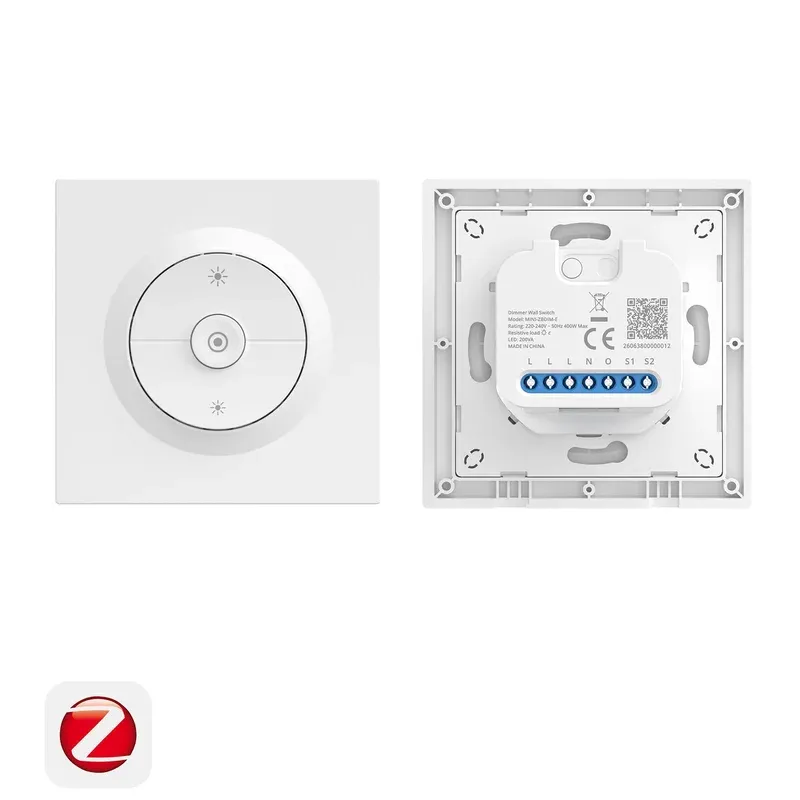
The SONOFF MINI-ZBDIM-E is a Zigbee wall dimmer that swaps a plain on-off switch for smooth 0 to 100% control. It's the piece that turns a harsh overhead light into something you can actually live under in the evening. Add it to a Zigbee hub and the same dimmer that softens your living room at night can also brighten gently at your wake-up time, all without touching a phone. One wiring detail decides whether it fits your home, so read on before you buy.
What the MINI-ZBDIM-E Does
At its core this is a dimming module built into a wall-switch form factor. It reads your bulb, calibrates itself, and then delivers steady brightness across the whole range instead of the buzzing, stepped dimming that cheaper units produce. Because it runs on Zigbee, it also doubles as a mesh router, quietly extending your network to sensors and switches further from the hub.
- Smooth 0 to 100% dimming with auto and manual calibration
- Flicker-free performance tuned to each bulb
- Real-time power monitoring to track energy use
- Overload, overcurrent, and overheat protection
- Works with eWeLink, Alexa, Google Assistant, and Home Assistant
- Acts as a Zigbee router to strengthen the mesh
The Neutral Wire Question
Here's the detail that trips people up. The MINI-ZBDIM-E needs a neutral wire in the switch box. Plenty of older homes, especially outside newer builds, only run live and switched-live to a wall switch, with no neutral in sight. If that's your situation, this dimmer simply won't power on, and no amount of app fiddling will fix it.
So before you order, pull your existing switch plate and look. Three or more wires with a neutral bundle? You're set. Only two wires? You'll want a no-neutral alternative instead. Five minutes with a screwdriver saves a return.
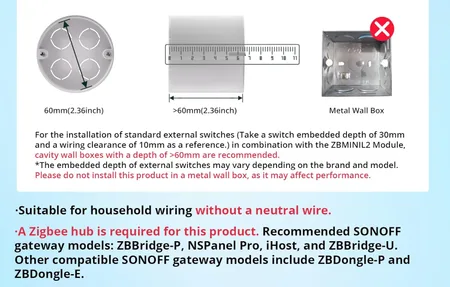
Because I'm building rather than retrofitting, I got to make that question disappear before the walls closed. A neutral runs into every switch box in my house, and every box is the deepest model available, so a smart module fits behind any plate. Both decisions cost close to nothing while the walls were open. Retrofitting either one costs you a wall. If you're at the cable stage of a build and happen to be reading a dimmer spec sheet, that's the paragraph worth acting on today.
Getting the Dimming Right
The best feature here is the flicker-free calibration. Cheap dimmers assume every bulb behaves the same, which is why so many LED setups flicker or refuse to dim below 40%. This unit runs an auto-calibration pass and lets you fine-tune manually, matching its output curve to your specific bulbs. The result is soft, continuous dimming rather than the jarring jumps you get from a mismatched dimmer.
Just mind the load list. Dimmable LED, incandescent, and halogen bulbs are fine. Fluorescent tubes, CFLs, LED strips, and anything inductive like a ceiling fan are not. Pairing it with the wrong load is the most common reason a dimmer underperforms, and it isn't the dimmer's fault.
Where It Fits
This dimmer makes the most sense in a Zigbee home that already runs a hub, whether that's the SONOFF bridge, a Home Assistant coordinator, or another Zigbee 3.0 gateway. Drop it into a living room, bedroom, or hallway where you want mood lighting on a schedule, and it earns its place quickly. It won't replace a full lighting system, and it demands that neutral wire, but for smooth, reliable dimming that also props up your mesh, the MINI-ZBDIM-E is a sensible, affordable pick.
Pair it with a motion sensor and a sunset schedule, and a hallway that used to blast full brightness at midnight becomes a gentle, low glow instead. That's the kind of small, daily improvement that makes automation worth the effort.
The Failure Mode a Local Dimmer Saves You From
My own lighting is wired the opposite way to what this dimmer assumes, and that contrast is the genuinely useful part of this review.
There are no 3-way circuits anywhere in my house. The bulbs are permanently live, every room has one global switch, and that room's entire lighting run lands in a single deep box. The design hands switching to Home Assistant. The electrician's reaction is the detail I keep repeating to people: he said the lighting was unusually simple work, because there were no stairwell circuits to pull and no intermediate switches to trace. Automation is supposed to complicate an installation. Here it did the reverse, since control from several points stopped being a copper problem and became a software one.
The price fits in a sentence. When Home Assistant is down, the lights in my house won't switch. That's a consequence of the design, not an outage I've lived through, and the UPS under the server softens it. The wall switch is an input to a system, not a break in a circuit, and an input nobody reads is just a click.
A MINI-ZBDIM-E doesn't charge that price. It sits between the supply and the lamp and dims the lamp itself, so as long as the module has power, a physical input wired to it keeps dimming that light regardless of whether the coordinator is awake or the network is having a bad night. Decoupling the button so it fires scenes instead is a choice you make in software, not a property of the wiring. That's the honest case for a module like this one over my layout: it keeps a hardware path from finger to filament, and my house deliberately doesn't have one. I still prefer my version, and I think a fallback you'd rarely need is a thin reason to run extra cable, but if the light in question hangs over a staircase I'd think about it twice.
Living With a Smart Dimmer
A smart dimmer changes how a room feels more than most gadgets in a connected home. A plain switch gives you two states, on and off, and both are usually wrong for the evening. Full brightness feels clinical after dark, and off means fumbling for a lamp. Sitting a dimmer in between fixes that daily friction, and once it runs on a schedule you stop thinking about it at all. The lights simply match the time of day.
There's a practical safety angle too, and it's easy to overlook. The overload, overcurrent, and overheat protection built into this unit matters more in a wall box than it does on a plug-in gadget, because a fault behind the plaster is far harder to notice. Knowing the dimmer will cut itself off rather than cook quietly inside the wall is worth something, especially in an older home where the wiring has already seen a few decades of service.
The last thing worth saying is that a good dimmer is boring in the best way. Once the brightness curves are tuned and the schedules set, a dimmer like this should disappear into the routine. You notice it only when it misbehaves. That quiet reliability, more than any single spec, is what separates a dimmer worth installing from one you rip back out a month later.
The power monitoring deserves a closer look as well, because it is more than a number in an app. Seeing exactly how much a dimmed circuit draws makes it obvious how much energy those evening hours actually cost, and it settles the old argument about whether dimming saves power. It does, and the figure is right there in eWeLink rather than buried in a utility bill three months later. For anyone tracking household energy use seriously, that per-circuit visibility turns a lighting upgrade into a small, measurable win rather than a guess. The Wi-Fi Sonoff D1 is the cheaper option, at around $15 to $18.
Frequently Asked Questions
Does the SONOFF MINI-ZBDIM-E need a neutral wire?
Yes. The MINI-ZBDIM-E (also sold as Orb-ZBDIM) requires a neutral wire in the switch box. If your wall box only has live and switched-live, this dimmer will not work and you need a no-neutral model instead.
What bulbs work with this dimmer?
Dimmable LED, incandescent, and halogen bulbs, plus dimmable electronic transformers for ELV systems. It does not support fluorescent lamps, CFLs, LED strips, or inductive loads like motors and fans.
Does it work with Alexa and Google Home?
Yes. Once added to the eWeLink app it links to Amazon Alexa, Google Assistant, and Home Assistant, so you can dim by voice or fold the light into wider automations.
Can it extend my Zigbee network?
Yes. Because it is mains-powered, the MINI-ZBDIM-E acts as a Zigbee router, relaying signals for other devices and strengthening the self-healing mesh around it.