Mill Smart Kitchen Products
Mill makes smart kitchen appliances including the EC03 food recycler, an app-controlled composter that reduces food waste with Wi-Fi monitoring.
Products
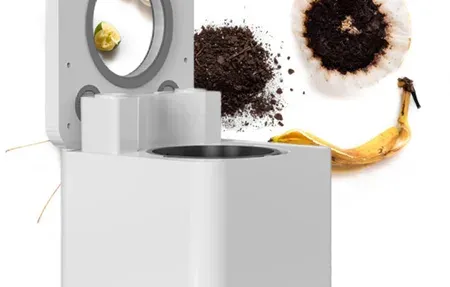
Mill Smart Kitchen Composter EC03: app-controlled food recycler with dry, shrink, and...
Mill is a Norwegian consumer electronics brand focused on smart home appliances, best known in the smart kitchen space for the Mill Smart Kitchen Composter EC03 food recycler. Mill designs its products around app connectivity and usage tracking, a different approach from most kitchen appliances that operate entirely offline.
Mill's product strategy centers on hardware that generates data. The EC03 food recycler connects to the Mill app over Wi-Fi and logs cumulative food waste processed, cycle history, and CO2 equivalent metrics. This data-forward design is unusual in the kitchen appliance segment, where most products offer no connectivity at all.
The Mill Smart Kitchen Composter EC03
The EC03 is Mill's flagship smart kitchen product. It's an electric food recycler that takes raw food scraps and reduces them to about 20% of their original volume through a combination of heat, airflow, and grinding. The output, Mill calls it "Food Grounds", is a dry, coffee-ground-like powder that breaks down quickly when added to garden soil or a standard outdoor compost bin.
The three-phase cycle runs 3-8 hours depending on how much is loaded. First, the unit removes moisture using heat. Second, it mechanically shrinks and compacts the material. Third, the de-smell cycle runs airflow through a carbon filter to manage odors before the lid is opened. Most users run it overnight and empty it in the morning.
The 5L internal chamber handles a household's daily food scraps with room to spare. A family generating 1-2 liters of food waste daily can run the EC03 every 2-3 days rather than every day. Volume reduction is the primary practical benefit, fewer trips to the compost bin, no liquid odor from wet scraps sitting in a traditional container.
Wi-Fi and App Integration
The Mill app connects via 2.4 GHz Wi-Fi and provides cycle status, start/stop controls, completion notifications, and a usage log. Remote start is genuinely useful: if you add scraps to the unit late in the evening, you can delay the cycle start until you're ready to sleep without walking back to the kitchen to press the button.
The cumulative tracking, how many kilograms processed, how many CO2 equivalents diverted from landfill, is basic but useful for households that track sustainability metrics. Mill is one of few kitchen appliance brands that surfaces this data to users at all.
There is no integration with Google Home, Alexa, or Apple HomeKit. The Mill app is the only control interface. Home Assistant community integrations don't exist for the EC03 as of 2026.
Noise and Placement
Mill rates the EC03 at 45 dB during operation. That's comparable to a quiet dishwasher or a running refrigerator. At that level, it's audible in a quiet kitchen but not enough to disrupt conversation or interfere with sleep in an adjacent room.
Ventilation clearance matters. The unit exhausts through a rear vent and needs at least 4 inches of clearance behind it. Standard countertop placement works. Enclosed cabinets with the door shut trap heat and shouldn't be used.
What the EC03 Doesn't Produce
The EC03 doesn't produce finished compost. The output is a pre-compost material, partially broken down, dry, reduced in volume, but not biologically complete. It needs additional time in outdoor soil or a traditional compost bin to finish the process. For apartment dwellers without outdoor access, the output still needs to go somewhere: building compost programs, community gardens, or municipal green waste collection.
Mill is transparent about this in their documentation. Calling the EC03 a "composter" is technically imprecise, it's more accurately a food waste dehydrator and volume reducer that produces a material that composts quickly. That's still genuinely useful, but it's worth understanding before purchasing.
EC03 vs Lomi by Pela
The most common alternative is Lomi by Pela (Classic at $499). Both are electric kitchen food recyclers using heat and grinding. Key differences: Lomi offers three distinct output modes (dirt, Lomi-approved, and certified compostables) for different composting applications. The Mill EC03 focuses on Wi-Fi connectivity and usage tracking rather than mode flexibility. Noise levels and cycle times are comparable between the two. Lomi operates without a Wi-Fi connection; the Mill app is central to the EC03 experience.
For users who want app monitoring and remote start, Mill's EC03 is the stronger option. For users who want mode flexibility for different compostable inputs, Lomi's design is more targeted.
Filter Maintenance
The EC03 uses a carbon filter to control odors during the de-smell phase. Mill recommends replacing the filter every 3-6 months depending on how often the unit runs. A household running a cycle daily will need replacement closer to every 3 months; weekly users can stretch to 6 months. Replacement filters are sold directly by Mill. This ongoing cost is worth factoring in when comparing the EC03 to simpler kitchen compost bins.
Mill vs Traditional Composting
The EC03 solves a specific problem: raw food scraps sitting in a kitchen bin smell, attract pests, and require frequent emptying. The EC03 eliminates the smell and moisture while dramatically reducing the volume. The processed output is far easier to handle than wet scraps, it doesn't smell, doesn't leak, and doesn't need to be emptied as often.
Traditional composting is cheaper and produces richer output, but it requires outdoor space, doesn't handle meat and dairy well, and takes weeks to months to produce usable compost. The EC03 works indoors, accepts most food types, and completes in hours rather than months. At around $299-350, it's a significant purchase for a single-purpose appliance, but one with a clear use case for households that generate significant food waste.